


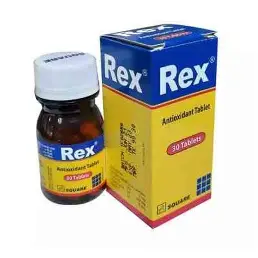
Rex Tablets ( Pot )
Made in:
Brand:
Capacity:

Authentic Product

Easy Return

Secure payments and fast deliveries
Indications The active ingredients i.e. the antioxidants present in each tablet, namely Vitamin A, Vitamin C & Vitamin E have been linked with reduced risks of […]
Indications
Vitamin E may also be of value in reversing the age-related trend toward decreased competence of the immune system, as well as other age-related degenerative changes.
Vitamin C plays an important part in the response of the body to stress. It is important in the defense against infection. Vitamin C possesses some anti-inflammatory activity and protects cells against oxidative damage to essential molecules. Vitamin C increases iron absorption.
The primary role of Vitamin E is the prevention of oxidation of polyunsaturated fatty acids. Vitamin E reacts with free radicals which are the cause of oxidative damage to cell membranes, without the formation of another free radical in the process.
- Beta carotene (Pro-Vitamin A) USP 6 mg
- Vitamin C (Ascorbic acid) BP 200 mg
- Vitamin E (Alpha Tocopherol) BP 50 mg
Vitamin C is the most powerful reducing agent known to be present in living tissues. Vitamin C deficiency produces scurvy. It is a cofactor in numerous biological processes. Vitamin C and molecular oxygen are essential for the conversion of proline to hydroxyproline, dopamine to noradrenaline . Vitamin C is also essential for the synthesis of adrenal steroid hormones. Vitamin C is important in the defense against infection and studies shown that vitamin C is important for the normal functioning of T-lymphocyte and leukocyte. Ascorbic acid has some antiinflammatory activity and protects cells against oxidation of essential molecules. In high doses, (1-2 g daily) ascorbic acid increases iron absorption.
vitamin E seems to be as a defense against oxidative stress and lipid peroxidation. In most cell membranes there is one molecule of tocopherol for every 1000 lipid molecules. Tocopherol mops up peroxide radicals and then needs a supply of reduced hydrogen to restore the steady-state situation. This is usually supplied by ascorbic acid or reduced glutathione.
Dosage & Administration
Interaction
Vitamin C is incompatible in solution with aminophylline, bleomycin, erythromycin, lactobionate, nafcillin, nitrofurantoin sodium, conjugated oestrogens, sodium bicarbonate, sulphafurazole diethanolamine, chloramphenicol sodium succinate, chlorothiazide sodium and hydrocortisone sodium succinate. It increases the apparent half-life of paracetamol and enhances iron absorption from the gastro-intestinal tract.
Contraindications
patients with hyperoxaluria. A pregnant woman taking more than 5 gm daily ascorbate may suffer fetal abortion. Higher doses of Vitamin C have been reported to cause failure of conception. In case of Vitamin E, there are no absolute contraindication.
Side Effects
Vitamin C is usually well tolerated. Large doses are reported to cause diarrhoea and other gastro-intestinal disturbances. It has also been stated that doses may result in hyperoxaluria and the formation of renal calcium oxalate calculi and it should therefore be given with care to patients with hyperoxaluria.
Vitamin E is usually well tolerated. Large doses may cause diarrhoea, abdominal pain, and other gastro-intestinal disturbances, and have also been reported to cause fatigue and weakness.
Pregnancy & Lactation
Vitamin C: The drug is safe in normal doses in pregnant women, but a daily intake of 5 g or more is reported to have caused abortion. The drug may be taken safely during lactation.
Vitamin E: The drug may be used in the normally recommended dose, but the safety of high-dose therapy has not been established. There appears to be no contraindication to breast-feeding by mothers taking the normally recommended dose.
Precautions & Warnings
Therapeutic Class
Storage Conditions
| Capacity | 30 Tablets ( Pot ) |
|---|
Related products
- Capacity: 10 Tablets (1 Strip)
Original price was: ৳ 12.00.৳ 11.00Current price is: ৳ 11.00.
- Capacity: 10 Tablets (1 Strip)
৳ 80.00
৳ 60.41
- Capacity: 10 tablet ( 1strip )
৳ 120.40
- Capacity: 10 Tablets (1 Strip)
৳ 150.00


Reviews
There are no reviews yet.