


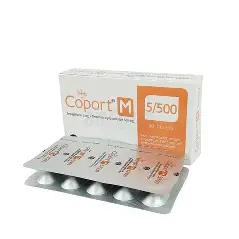
Coport M 5/500mg Tablet
Made in:
Brand:
Capacity:

Authentic Product

Easy Return

Secure payments and fast deliveries
Indications Coport M tablet is indicated for the treatment of adults with type 2 diabetes mellitus as an adjunct to diet and exercise: In patients insufficiently […]
Indications
- In patients insufficiently controlled on their maximally tolerated dose of Metformin alone
- In combination with other medicinal products for the treatment of diabetes, in patients insufficiently controlled with Metformin and these medicinal products
- In patients already being treated with the combination of Empagliflozin and Metformin as separate tablets.
Metformin Hydrochloride is a biguanide type oral antihyperglycemic drug, used in the management of type 2 diabetes. It lowers both basal and postprandial plasma glucose. It does not produce hypoglycemia. Metformin Hydrochloride decreases hepatic glucose production, decreases intestinal absorption of glucose and improves insulin sensitivity by an increase in peripheral glucose uptake and utilization.
Recommended individualized starting dose:
- In patients on Metformin Hydrochloride, switch to this combination containing Empagliflozin 5 mg with a similar total daily dose of Metformin Hydrochloride.
- In patients on Empagliflozin, switch to this combination containing Metformin Hydrochloride 500 mg with a similar total daily dose of Empagliflozin.
- In patients already treated with Empagliflozin and Metformin Hydrochloride separately switch to this combination containing the same total daily doses of each component.
- In patients with volume depletion not previously treated with Empagliflozin, correct this condition before initiating this combination.
Extended-release formulations: Individualize starting dose based on the patient’s current drug regimen. Take film coated tablet twice daily with meal and extended-release formulations should be taken once daily with meal, with gradual dose escalation to reduce the Gl adverse effects due to Metformin. Adjust dosing based on effectiveness and tolerability while not exceeding the maximum recommended daily dose of Metformin Hydrochloride 2000 mg and Empagliflozin 25 mg.
Renal impaired patient: Assess renal function before initiating this combination. In patients with an eGFR below 45 mL/min/1.73 m2 is contraindicated.
Pediatric patients under 18 years of age: Safety and effectiveness in pediatric patients under 18 years of age have not been established.
Insulin or Insulin Secretagogues: Co-administration of Empagliflozin with insulin or insulin secretagogues increases the risk for hypoglycemia.
Positive Urine Glucose Test: Monitoring glycemic control with urine glucose tests is not recommended in patients taking SGLT2 inhibitors. Use alternative methods to monitor glycemic control.
Drugs that Reduce Metformin Clearance: Drugs that reduce Metformin clearance (such as ranolazine, vandetanib, dolutegravir, and cimetidine) may increase the accumulation of Metformin.
Carbonic Anhydrase Inhibitors: Carbonic anhydrase inhibitors may increase risk of lactic acidosis.
Drugs Affecting Glycemic Control: Thiazides and other diuretics, corticosteroids, phenothiazines, thyroid products, estrogens, oral contraceptives, phenytoin, nicotinic acid, sympathomimetics, calcium channel blocking drugs, and isoniazid produce hoperglycemia. When such drugs are administered to a patient receiving Empagliflozin and Metformin combination, the patient should be closely observed to maintain adequate glycemic control. When such drugs are withdrawn from a patient receiving Empagliflozin and Metformin combination, the patient should be observed closely for hypoglycemia.
Alcohol: Alcohol can potentiate the effect of Metformin on lactate metabolism. Warn patients against excessive alcohol intake.
- Hypersensitivity to Empagliflozin and Metformin
- Any type of acute metabolic acidosis (such as lactic acidosis, diabetic ketoacidosis)
- Diabetic pre-coma
- Severe renal failure (GFR <30 ml/min)
- Acute conditions with the potential to alter renal function such as: dehydration, severe infection, shock
- Disease which may cause tissue hypoxia (especially acute disease, or worsening of chronic disease) such as: decompensated heart failure, respiratory failure, recent myocardial infarction, shock
- Hepatic impairment, acute alcohol intoxication, alcoholism
- Very common: Hypoglycemia (when used with sulphonylurea or insulin), Gastrointestinal symptoms
- Common: Vaginal moniliasis, vulvovaginitis, balanitis and other genital infection. Urinary tract infection (including pyelonephritis and urosepsis), thirst, taste disturbance, pruritus (generalised), rash, Increased urination, serum lipids increased
- Uncommon: Volume depletion, urticaria, dysuria, blood creatinine increased/Glomerular filtration rate decreased, Haematocrit increased
- Rare: Diabetic ketoacidosis.
Pregnancy & Lactation
Precautions & Warnings
Hypotension: Before initiating Coport M assess and correct volume status in patients with renal impairment, the elderly, in patients with low systolic blood pressure, and in patients on diuretics. Monitor for signs and symptoms of hypotension after initiating therapy and increase monitoring in clinical situations where volume contraction is expected.
Ketoacidosis: Before initiating Coport M assess patients who present with signs and symptoms of metabolic acidosis for ketoacidosis, regardless of blood glucose level. If suspected, discontinue Coport M, evaluate and treat promptly.
Acute kidney injury & impairment in renal function: Consider temporarily discontinuing Coport M in settings of reduced oral intake or fluid losses. If acute kidney injury occurs, discontinue Coport M promptly and institute treatment.
Urosepsis, Pyelonephritis, Fournier’s gangrene & Genital mycotic infections: Treatment with SGLT2 inhibitors increases the risk for urinary tract infections. Evaluate patients for signs and symptoms of urinary tract infections and treat promptly, if indicated.
Hypoglycemia: Consider lowering the dose of insulin secretagogue or insulin to reduce the risk of hypoglycemia when initiating Coport M.
Vitamin B12 Deficiency: Metformin Hydrochloride may lower vitamin B12 levels. Monitor hematologic parameters annually.
Increased LDL-C: Monitor and treat as appropriate.
Macrovascular Outcomes: There have been no clinical studies establishing conclusive evidence of macrovascular risk reduction with Coport M.
Overdose Effects
| Capacity | 10 Tablets (1 Strip) |
|---|
Related products
- Capacity: 10 Tablets (1 Strip)
৳ 60.20
- Capacity: 10 Tablets (1 Strip)
৳ 120.40
- Capacity: 10 Tablets (1 Strip)
Original price was: ৳ 12.00.৳ 11.00Current price is: ৳ 11.00.
- Capacity: 10 Tablets (1 Strip)
৳ 80.00
- Capacity: 10 tablet ( 1strip )
৳ 120.40


Reviews
There are no reviews yet.