


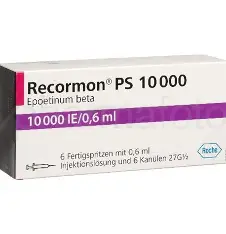
Recormon IV/SC Injection 10000-IU
Made in:
Brand:
Capacity:

Authentic Product

Easy Return

Secure payments and fast deliveries
Indications Recormon is indicated for: Treatment of symptomatic anemia associated with chronic kidney disease (CKD) in patients on dialysis. Treatment of symptomatic renal anemia in patients […]
Indications
- Treatment of symptomatic anemia associated with chronic kidney disease (CKD) in patients on dialysis.
- Treatment of symptomatic renal anemia in patients not yet undergoing dialysis.
- Prevention of anemia of prematurity in infants with a birth weight of 750 to 1500 g and a gestational age of less than 34 weeks.
- Treatment of symptomatic anemia in adult patients with non-myeloid malignancies receiving chemotherapy.
- Increasing the yield of autologous blood from patients in a pre-donation programme.
Its use in this indication must be balanced against the reported increased risk of thromboembolic events. Treatment should only be given to patients with moderate anemia (Hb 10–13 g/dl [6.21–8.07 mmol/l], no iron deficiency) if blood conserving procedures are not available or insufficient when the scheduled major elective surgery requires a large volume of blood (4 or more units of blood for females or 5 or more units for males).
Dosage & Administration
Substitution by any other biological medicinal product requires the consent of the prescribing physician.
The Recormon pre-filled syringe is ready for use. Only solutions which are clear or slightly opalescent, colourless and practically free of visible particles may be injected.
Recormon in pre-filled syringe is a sterile but unpreserved product. Under no circumstances should more than one dose be administered per syringe.
Treatment of anemic patients with chronic renal failure: The solution can be administered subcutaneously or intravenously. In case of intravenous administration, the solution should be injected over approximately 2 minutes, e.g. in hemodialysis patients via the arteriovenous fistula at the end of dialysis.
For non-hemodialysed patients, subcutaneous administration should always be preferred in order to avoid puncture of peripheral veins.
The recommended hemoglobin target is 10 -12 g/dl. The target hemoglobin should be determined individually in the presence of hypertension or existing cardiovascular, cerebrovascular or peripheral vascular diseases. It is recommended that hemoglobin is monitored at regular intervals (e.g. every two to four weeks) until stabilised and periodically thereafter.
Treatment with Recormon is divided into two stages: Correction phase-
Subcutaneous administration: The initial dosage is 3 x 20 IU/kg body weight per week. The dosage may be increased every 4 weeks by 3 X 20 IU/kg body weight/week if the Hb increase is not adequate (Hb <1.5 g/L per week). The weekly dose can also be divided into daily doses.
Intravenous administration: The initial dosage is 3 x 40 IU/kg per week. The dosage may be raised after 4 weeks to 80 IU/kg – three times per week- and by further increments of 20 IU/kg if needed, three times per week, at monthly intervals.
For both routes of administration, the maximum dose should not exceed 720 IU/kg per week.
Interaction
Contraindications
- Known hypersensitivity to the active substance or any of the excipients.
- Poorly controlled hypertension.
In the indication “increasing the yield of autologous blood”, Recormon must not be used in patients who, in the month preceding treatment, have suffered a myocardial infarction or stroke, patients with unstable angina pectoris, or patients who are at increased risk of deep venous thrombosis such as those with a history of venous thromboembolic disease.
Side Effects
Pregnancy & Lactation
Lactation: Only limited experience in human lactation has been gained. Endogeneous erythropoietin is excreted in breast milk and readily absorbed by the neonatal gastrointestinal tract. A decision on whether to continue or discontinue breastfeeding or to continue or discontinue therapy with epoetin beta should be made taking into account the benefit of breastfeeding to the child and the benefit of epoetin beta therapy to the woman.
Use in Special Populations
Geriatric use: No dedicated studies in geriatric patients were performed. A large proportion of geriatric patients were included in clinical trials with Recormon. A need for special dose adjustments in the geriatric population was not identified.
Hepatic Impairment: No dedicated clinical trials were conducted in patients with hepatic impairment. No special dosage Instructions are available.
Overdose Effects
Therapeutic Class
Storage Conditions
| Capacity | Injaction |
|---|
Related products
- Capacity: 10 Tablets (1 Strip)
৳ 450.00
- Capacity: 10 Tablets (1 Strip)
৳ 220.00
- Capacity: 10 Tablets (1 Strip)
৳ 60.20
- Capacity: 10 Tablets (1 Strip)
৳ 100.30
- Capacity: 10 Tablets (1 Strip)
৳ 120.00


Reviews
There are no reviews yet.