


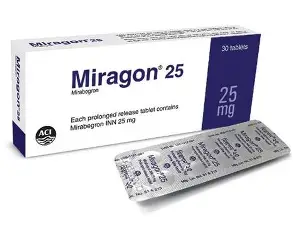
Miragon 25mg Tablets
Made in:
Brand:
Capacity:

Authentic Product

Easy Return

Secure payments and fast deliveries
Indications Miragon tablet is indicated for the symptomatic treatment of urgency, increased micturition frequency and urgency incontinence as may occur in adult patients with overactive bladder […]
Indications
Dosage & Administration
Renal or hepatic impairment:
- Patients with severe renal impairment (ClCr 15 to 29 mL/min or eGFR 15 to 29 mL/min/1.73 m2) or moderate hepatic impairment (Child-Pugh Class B), the daily dose of Mirabegron should not exceed 25 mg tablet once daily.
- Mirabegron has not been studied in patients with end stage renal disease (GFR <15 mL/min/1.73 m2 or patients requiring haemodialysis) or severe hepatic impairment (Child Pugh Class C) and it is therefore not recommended for use in these patient populations.
Gender: No dose adjustment is necessary according to gender.
Paediatric population: The safety and efficacy of Mirabegron in children below 18 years of age have not yet been established.
Mirabegron tablet is to be taken once daily, with liquids, swallowed whole and is not to be chewed, divided, or crushed.
Interaction
Effect of enzyme inducers: Substances that are inducers of CYP3A or P-gp decrease the plasma concentrations of Miragon. No dose adjustment is needed for Miragon when administered with therapeutic doses of rifampicin or other CYP3A or P-gp inducers.
Effect of Miragon on CYP2D6 substrates: In healthy volunteers, the inhibitory potency of Miragon towards CYP2D6 is moderate and the CYP2D6 activity recovers within 15 days after discontinuation of Miragon. Multiple once daily dosing of Miragon IR resulted in a 90% increase in Cmax and a 229% increase in AUC of a single dose of metoprolol. Multiple once daily dosing of Miragon resulted in a 79% increase in Cmax and a 241% increase in AUC of a single dose of desipramine. Caution is advised if Miragon is co-administered with medicinal products with a narrow therapeutic index and significantly metabolised by CYP2D6, such as thioridazine, Type 1 C antiarrhythmics (e.g., flecainide, propafenone) and tricyclic antidepressants (e.g., imipramine, desipramine). Caution is also advised if Miragon is co-administered with CYP2D6 substrates that are individually dose titrated.
Effect of Miragon on transporters: Miragon is a weak inhibitor of P-gp. Miragon increased Cmax and AUC by 29% and 27%, respectively, of the P-gp substrate digoxin in healthy volunteers. For patients who are initiating a combination of Miragon and digoxin, the lowest dose for digoxin should be prescribed initially. Serum digoxin concentrations should be monitored and used for titration of the digoxin dose to obtain the desired clinical effect.
Other interactions: No clinically relevant interactions have been observed when Miragon was co-administered with therapeutic doses of solifenacin, tamsulosin, warfarin, metformin or a combined oral contraceptive medicinal product containing ethinylestradiol and levonorgestrel. Dose-adjustment is not recommended.
Contraindications
Pregnancy & Lactation
Precautions & Warnings
Hepatic impairment: Miragon has not been studied in patients with severe hepatic impairment (Child-Pugh Class C) and, therefore, it is not recommended for use in this patient population. Miragon is not recommended for use in patients with moderate hepatic impairment (Child-Pugh Class B) concomitantly receiving strong CYP3A inhibitors.
Hypertension: Miragon can increase blood pressure. Blood pressure should be measured at baseline and periodically during treatment with Miragon, especially in hypertensive patients. Data are limited in patients with stage 2 hypertension (systolic blood pressure 160 mm Hg or diastolic blood pressure 100 mm Hg).
Patients with congenital or acquired QT prolongation: Caution should be exercised when administering Miragon in patients with congenital or acquired QT prolongation.
Patients with bladder outlet obstruction and patients taking antimuscarinics medications for OAB: A controlled clinical safety study in patients with bladder outlet obstruction (BOO) did not demonstrate increased urinary retention in patients treated with Miragon; however, Miragon should be administered with caution to patients with clinically significant bladder outlet obstruction. Miragon should also be administered with caution to patients taking antimuscarinic medications for the treatment of OAB.
Overdose Effects
Therapeutic Class
Storage Conditions
| Capacity | 10 Tablets (1 Strip) |
|---|
Related products
- Capacity: 10 Tablets (1 Strip)
৳ 120.00
- Capacity: 10 Tablets (1 Strip)
৳ 80.00
- Capacity: 10 Tablets (1 Strip)
৳ 200.00
৳ 60.41
- Capacity: 10 Tablets (1 Strip)
৳ 280.00



Reviews
There are no reviews yet.