


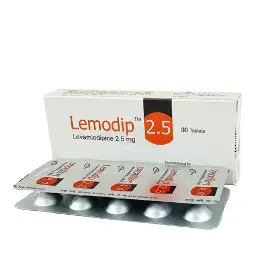
Lemodip 2.5-MG Tablet
Made in:
Brand:
Capacity:

Authentic Product

Easy Return

Secure payments and fast deliveries
Indications Lemodip is calcium channel blocker and may be used alone or in combination with other antihypertensive agents for the treatment of hypertension, to lower blood […]
Indications
Absorption: Oral Levamlodipine has a Tmax of 6-12 h and a bioavailability of 64-90%. Absorption of Levamlodipine is not significantly affected by food.
Distribution: The volume of distribution of Levamlodipine is similar to amlodipine. The volume of distribution of amlodipine is 21 L/kg.
Metabolism and Excretion: Levamlodipine is 90% metabolized to inactive metabolites. Incubation with liver microsomes has shown that this metabolism is primarily mediated by CYP3A4. This derivative can be further oxidatively deaminated or O-dealkylated, but does not appear to undergo O-demethylation like racemic amlodipine. Levamlodipine is 60% eliminated in urine with 10% eliminated as the unmetabolized drug.
Dosage & Administration
Dosage: The usual initial antihypertensive oral dose of Levamlodipine is 2.5 mg once daily, and the maximum dose is 5 mg once daily.
Adult and elderly patients: Elderly patients, or patients with hepatic insufficiency may be started on 1.25 mg once daily and this dose may be used when adding Levamlodipine to other antihypertensive therapy. Dosage needs to be adjusted according to blood pressure goals. 7 to 14 days waiting period between titration steps is needed. Titration needs to be done more rapidly, however, if clinically warranted, provided the patient is assessed frequently.
Use in children and adolescents: The effective antihypertensive oral dose in pediatric patients ages 6-17 years is 1.25 mg to 2.5 mg once daily. Doses in excess of 2.5 mg daily have not been studied in pediatric patients.
Interaction
- CYP3A Inhibitors: Co-administration with CYP3A inhibitors (moderate and strong) results in increased systemic exposure to amlodipine and may require dose reduction.
- CYP3A Inducers: No information is available on the quantitative effects of CYP3A inducers on amlodipine.
Impact of Amlodipine on other drugs:
- Simvastatin: Co-administration of simvastatin with amlodipine increases the systemic exposure of simvastatin. Limit the dose of simvastatin in patients on amlodipine to 20 mg daily.
- Immunosuppressants: Amlodipine may increase the systemic exposure of cyclosporine or tacrolimus when co-administered. Frequent monitoring of trough blood levels of cyclosporine and tacrolimus is recommended and adjust the dose when appropriate.
- With food and others: Can be taken with or without food. The absorption is unaffected by food. Avoid grapefruit products & natural licorice.
Contraindications
Side Effects
Rare: Diarrhea, Back pain, Headache, Fatigue & Nausea.
Pregnancy & Lactation
Precautions & Warnings
Increased Angina or Myocardial Infarction: Worsening angina and acute myocardial infarction can develop after starting or increasing the dose of amlodipine, particularly in patients with severe obstructive coronary artery disease.
Patients with Hepatic Failure: Because amlodipine is extensively metabolized by the liver and the plasma elimination half-life (t½) is 56 hours in patients with impaired hepatic function, titrate slowly when administering amlodipine to patients with severe hepatic impairment.
Overdose Effects
Therapeutic Class
Storage Conditions
| Capacity | 10 Tablets ( 1Strips ) |
|---|
Related products
- Capacity: 10 Tablets (1 Strip)
৳ 100.30
- Capacity: 10 Tablets (1 Strip)
৳ 125.00
- Capacity: 10 tablet ( 1strip )
৳ 30.10
- Capacity: 10 Tablets (1 Strip)
৳ 50.20
- Capacity: 10 Tablets (1 Strip)
৳ 250.00


Reviews
There are no reviews yet.