


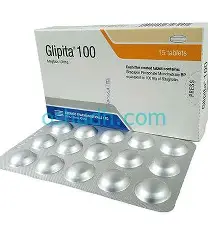
Glipita 100MG Tablet
Made in:
Brand:
Capacity:

Authentic Product

Easy Return

Secure payments and fast deliveries
Indications Monotherapy and Combination Therapy: Glipita is indicated as an adjunct to diet and exercise to improve glycemic control in adults with type 2 diabetes mellitus. […]
Indications
Monotherapy and Combination Therapy: Glipita is indicated as an adjunct to diet and exercise to improve glycemic control in adults with type 2 diabetes mellitus.
Important Limitations of Use: Glipita should not be used in patients with type 1 diabetes or for the treatment of diabetic ketoacidosis, as it would not be effective in these settings. Glipita has not been studied in patients with a history of pancreatitis. It is unknown whether patients with a history of pancreatitis are at increased risk for the development of pancreatitis while using Glipita.
Dosage & Administration
Interaction
Effects of Glipita on other Drugs: Glipita did not meaningfully alter the pharmacokinetics of metformin, glyburide, simvastatin, rosiglitazone, warfarin, or oral contraceptive.
Digoxin: Glipita slightly increases the mean of Digoxin concentration. However, no dose adjustment of either drug is required.
Contraindications
Side Effects
Pregnancy & Lactation
Precautions & Warnings
If pancreatitis is suspected, Glipita should promptly be discontinued and appropriate management should be initiated.
Use in Patients with Renal Insufficiency: Dosage adjustment is recommended in patients with moderate or severe renal insufficiency and in patients with ESRD requiring hemodialysis or peritoneal dialysis.
Use with medications known to cause Hypoglycemia: When Glipita is used in combination therapy dosage adjustment of sulfonylurea or insulin may be required to reduce the risk of hypoglycemia.
Hypersensitivity Reactions: There have been post-marketing reports of serious hypersensitivity reactions in patients treated with Glipita. These reactions include anaphylaxis, angioedema, and exfoliative skin conditions including Stevens-Johnson syndrome. If a hypersensitivity reaction is suspected, discontinue Glipita, assess for other potential causes for the event, and institute alternative treatment for diabetes.
Use in Special Populations
Pediatric Use: Safety and effectiveness of Glipita in pediatric patients under 18 years of age have not been established.
Geriatric Use: Glipita is known to be substantially excreted by the kidney. Because elderly patients are more likely to have decreased renal function, care should be taken in dose selection in the elderly, and it may be useful to assess renal function in these patients prior to initiating dosing and periodically thereafter.
For patients with mild renal insufciency: (CrCl <50 ml/min or serum creatinine levels of <1.7 mg/DL in men and <1.5 mg/DL in women), no dosage adjustment for Glipita is required.
For patients with moderate renal insufciency: (CrCl <30 to <50 mL/min, or serum creatinine levels of >1.7 to <3.0 mg/dL in men and >1.5 to <2.5 mg/dL in women), the dose of Glipita is 50 mg once daily.
For patients with severe renal insufficiency: (CrCl <30 mL/min or serum creatinine levels of >3.0 mg/dL in men and 2.5 mg/dL in women) or with end-stage renal disease (ESRD) requiring hemodialysis or peritoneal dialysis, the dose of Glipita is 25 mg once daily. Glipita may be administered without regard to the limiting of hemodialysis.
Overdose Effects
During controlled clinical trials in healthy subjects, single doses of up to 800 mg Glipita were administered. Maximal mean increases in QTc of 8.0 msec were observed in one study at a dose of 800 mg Glipita, a mean effect that is not considered clinically important. There is no experience with doses above 800 mg in clinical studies. In Phase I multiple-dose studies, there were no dose-related clinical adverse reactions observed with Glipita with doses of up to 600 mg per day for periods of up to 10 days and 400 mg per day for up to 28 days.
In the event of an overdose, it is reasonable to employ the usual supportive measures, e.g., remove unabsorbed material from the gastrointestinal tract, employ clinical monitoring (including obtaining an electrocardiogram), and institute supportive therapy as dictated by the patient’s clinical status. Glipita is modestly dialyzable. In clinical studies, approximately 13.5% of the dose was removed over a 3- to 4-hour hemodialysis session. Prolonged hemodialysis may be considered if clinically appropriate. It is not known if Glipita is dialyzable by peritoneal dialysis.
Therapeutic Class
Storage Conditions
| Capacity | 15 Tablets ( 1 Strips ) |
|---|
Related products
- Capacity: 10 Tablets (1 Strip)
৳ 120.00
- Capacity: 10 tablet ( 1strip )
৳ 120.40
- Capacity: 10 Tablets (1 Strip)
৳ 220.00
- Capacity: 10 Tablets (1 Strip)
৳ 280.00
- Capacity: 10 Tablets (1 Strip)
৳ 200.00


Reviews
There are no reviews yet.