


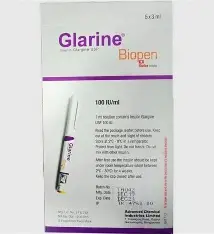
Glarine Biopen Injection 3ML
Made in:
Brand:
Capacity:

Authentic Product

Easy Return

Secure payments and fast deliveries
Indications Glarine is indicated to improve glycemic control in adults and children with type 1 diabetes mellitus and in adults with type 2 diabetes mellitus. Pharmacology […]
Indications
Insulin Glargine is recommended for once daily subcutaneous administration & may be administered at any time during the day. However, once started should be administered at the same time every day. The dose of Insulin Glargine must be individualized based on clinical response. Blood glucose monitoring is essential in all patients with diabetes. In patients with type 1 diabetes, Insulin Glargine must be used in regimens with short-acting insulin. Insulin Glargine is not recommended for intravenous administration. Intravenous administration of the usual subcutaneous dose could result in severe hypoglycemia.
Initiation of Insulin Glargine therapy:
- The recommended starting dose of Insulin Glargine in patients with type 1 diabetes should be approximately one-third of the total daily insulin requirements. Short-acting, premeal insulin should be used to satisfy the remainder of the daily insulin requirements.
- The recommended starting dose of Insulin Glargine in patients with type 2 diabetes who are not currently treated with insulin is 10 units (or 0.2 Units/kg) once daily, which should subsequently be adjusted to the patient’s needs.
Converting to Insulin Glargine from other insulin therapies: If changing from a treatment regimen with an intermediate-or long-acting insulin to a regimen with Insulin Glargine , the amount and timing of shorter-acting insulins and doses of any oral anti-diabetic drugs may need to be adjusted.
- If transferring patients from once-daily NPH insulin to once-daily Insulin Glargine , the recommended initial Insulin Glargine dose is the same as the dose of NPH that is being discontinued.
- If transferring patients from twice-daily NPH insulin to once-daily Insulin Glargine , the recommended initial Insulin Glargine dose is 80% of the total NPH dose that is being discontinued
Cartridge:
- Insert the Insulin Glargine cartridge into the pen correctly and equip the needle. Gently turn the pen upside down for 8-10 times until the insulin in the cartridge becomes uniformly mixed.
- Adjust the dosage button to get correct dose. After removal of the needle cap and discharge air bubbles in the cartridge, it is ready to be injected. In order to avoid cross contamination, do not let the needle touch anything during the process of preparation.
Vial:
- Firstly, clean your hands. Shake or rotate the vial gently to mix the solution uniformly and check if the insulin has the normal appearance.
- If using a new Insulin Glargine bottle then flip off the plastic protective cap and wipe the rubber stopper with an alcohol swab.
- Draw air into your syringe equal to the amount of Insulin Glargine needed. Puncture the needle into the vial and inject the air.
- Turn the bottle and syringe upside down. Withdraw correct dose of Insulin Glargine into the syringe. Before pulling out the needle, check if there are any bubbles remain in the syringe.
- If so, put the syringe upright and tap the syringe to discharge the air bubbles.
Injection Site: Choose the area where skin is less tight, such as the upper arm, thigh, buttock and abdomen, etc. To avoid tissue damage, choose a site for each injection that is at least 1 cm from the previous injection site.
Injection Method: Cleanse the skin with alcohol where the injection is to be made. Put the needle in such a position as to form 45° angle with the skin. Puncture the needle into skin and inject insulin. Then pull the needle out and apply gentle pressure over the injected site for several seconds. Do not rub the injection site.
Interaction
The following substances may reduce the Glarine as well as Glarine requirements: Oral anti-diabetic products, angiotensin converting enzyme (ACE) inhibitors, disopyramide, fibrates, fluoxetine, monoamine oxidase inhibitors, propoxyphene, pentoxifylline, salicylates and sulfonamide antibiotics.
The following substances may increase the Glarine as well as Glarine requirements: Thiazides, glucocorticoids, thyroid hormones, beta-sympathomimetics, growth hormone and danazol. Beta-blockers, clonidine, lithium salts, and alcohol may either potentiate or weaken the blood-glucose-lowering effect of insulin.
Contraindications
Side Effects
Pregnancy & Lactation
Precautions & Warnings
Administration: Glarine must not be diluted or mixed with any other insulin or solution. It should not be administered subcutaneously via an insulin pump or intravenously because severe hypoglycemia can occur.
Renal or hepatic impairment: Reduction in the Glarinedose may require in these cases.
Overdose Effects
Therapeutic Class
Storage Conditions
| Capacity | Insulin |
|---|
Related products
- Capacity: 10 Tablets (1 Strip)
৳ 350.00
- Capacity: 10 Tablets (1 Strip)
৳ 60.20
- Capacity: 10 tablet ( 1strip )
৳ 120.40
- Capacity: 10 Tablets (1 Strip)
৳ 280.00
- Capacity: 10 Tablets (1 Strip)
৳ 200.00


Reviews
There are no reviews yet.