


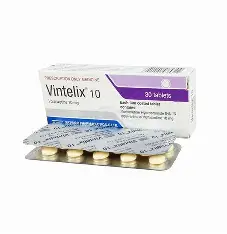
Vintelinx 10MG Tablets
Made in:
Brand:
Capacity:

Authentic Product

Easy Return

Secure payments and fast deliveries
Indications Vintelix is indicated for the treatment of major depressive disorder (MDD) in adults. Pharmacology The mechanism of the antidepressant effect of Vortioxetine is not fully […]
Indications
Dosage & Administration
Maintenance dose: For MDD, Vortioxetine can be administered for several months or longer. For a long period use patients should be re-evaluated to assess the usefulness of the drugs for individual patients.
Discontinuation treatment: Although Vortioxetine can be abruptly discontinued, in placebo-controlled trials patients experienced transient adverse reactions such as headache and muscle tension following abrupt discontinuation of Vortioxetine 15 mg/day or 20 mg/day. To avoid these adverse reactions, it is recommended that the dose should be decreased to 10 mg/day for one week before full discontinuation of Vortioxetine 15 mg/day or 20 mg/day.
Switching a patient to or from a Monoamine Oxidase Inhibitor (MAOI) intended to treat Psychiatric Disorders: At least 14 days must elapse between discontinuation of an MAOI intended to treat psychiatric disorders and initiation of therapy with Vortioxetine to avoid the risk of Serotonin Syndrome. Conversely, at least 21 days must elapse after stopping Vortioxetine before starting an MAOI intended to treat psychiatric disorders.
Interaction
Serotonergic drugs: Co-administration of Vintelix with other drugs that may affect the serotonergic neurotransmitter systems (e.g. SSRIs, SNRIs, Triptans, Buspirone, Tramadol, and Tryptophan products etc.) may potentially increase serotonin toxicity or serotonin syndrome. Closely monitor symptoms of serotonin syndrome if Vintelix is co-administered with other serotonergic drugs. Treatment with Vintelix and any concomitant serotonergic agents should be discontinued immediately if serotonin syndrome occurs.
Other CNS active agents: No clinically relevant effect was observed on steady-state Lithium exposure following co-administration with multiple daily doses of Vintelix.
Potential for other drugs to affect Vintelix: Reduce Vintelix dose by half when a strong CYP2D6 inhibitor (e.g. Bupropion, Fuoxetine, Paroxetine, Quinidine) is co-administered. Consider increasing the Vintelix dose when a strong CYP inducer (e.g. Rifampin, Carbamazepine, Phenytoin) is co-administered.
Contraindications
Side Effects
Pregnancy & Lactation
Precautions & Warnings
Serotonin Syndrome: The development of a potentially life-threatening serotonin syndrome has been reported with serotonergic antidepressants including Vintelix, when used alone but more often when used concomitantly with other serotonergic drugs (including Triptans, Tricyclic Antidepressants, Fentanyl, Lithium, Tramadol, Tryptophan, Buspirone & St. John’s Wort), and with drugs that impair metabolism of serotonin (in particular, MAOIs, both those intended to treat psychiatric disorders and also others, such as Linezolid and intravenous methylene blue).
Abnormal Bleeding: The use of drugs that interfere with serotonin reuptake inhibition, including Vintelix, may increase the risk of bleeding events. Concomitant use of Aspirin, Nonsteroidal
Anti-inflammatory drugs (NSAIDs), Warfarin, and other Anticoagulants may add to this risk. Activation of
Mania/Hypomania: As with all Antidepressants, use Vintelix cautiously in patients with a history or family history of bipolar disorder, mania, or hypomania.
Angle Closure Glaucoma: The pupillary dilation that occurs following the use of many Antidepressant drugs, including Vintelix, may trigger an angle closure attack in a patient with anatomically narrow angles who does not have a patent iridectomy.
Hyponatremia: Hyponatremia occurrs because of treatment with serotonergic drugs.
Use in Special Populations
Geriatrics use (>65 years of age): No dose adjustment is recommended on the basis of age. Results from a single-dose pharmacokinetic study in elderly (>65 years old) vs young (24 to 45 years old) subjects demonstrated that the pharmacokinetics were generally similar between the two age groups.
Renal impairment: No dose adjustment is needed.
Hepatic impairment: No dose adjustment is recommended for patients with mild or moderate hepatic impairment. Vintelix is not recommended in patients with severe hepatic impairment.
CYP2D6 poor metabolizers: The plasma concentration of Vintelix was approximately two times higher in CYP2D6 poor metabolizers than in extensive metabolizers. In the presence of strong CYP3A4/2C9 inhibitors, the exposure could potentially be higher, and a dosage adjustment may be required.
Use in other patient populations: No dose adjustment of Vintelix is needed on the basis of race, gender and ethnicity.
Overdose Effects
Therapeutic Class
Storage Conditions
| Capacity | 10 Tablets ( 1Strips ) |
|---|
Related products
- Capacity: 10 Tablets (1 Strip)
৳ 50.20
- Capacity: 10 Tablets (1 Strip)
৳ 100.30
- Capacity: 10 Tablets (1 Strip)
৳ 450.00
৳ 60.41
- Capacity: 10 Tablets (1 Strip)
৳ 120.00



Reviews
There are no reviews yet.