


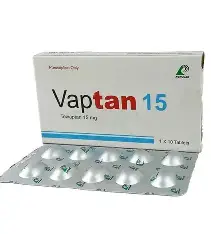
Vaptan 15-MG Tablet
Made in:
Brand:
Capacity:

Authentic Product

Easy Return

Secure payments and fast deliveries
Indications Vaptan is indicated in- Hypervolemic or euvolemic hyponatremia. Autosomal dominant polycystic kidney disease. Pharmacology Tolvaptan is a selective vasopressin V2-receptor antagonist. Tolvaptan affinity for the […]
Indications
- Hypervolemic or euvolemic hyponatremia.
- Autosomal dominant polycystic kidney disease.
Dosage & Administration
Autosomal dominant polycystic kidney disease (ADPKD):
- Initially: 60 mg/day in divided doses (given as 45 mg upon wakening and 15 mg 8 hours later);
- Titrate per response and tolerability at intervals of at least 7 days between titrations to 90 mg/day in divided doses (given as 60 mg upon wakening and 30 mg 8 hours later) followed by 120 mg/day in divided doses (given as 90 mg upon wakening and 30 mg 8 hours later).
- Maintain urine osmolality of <300 mOsm/kg if possible; if the maximum dose is not tolerated, administration of a lower dose with the goal of achieving urine osmolality of 250 to 300 mOsm/kg is reasonable
Interaction
- CYP 3A Inhibitors: Vaptan is a substrate of CYP 3A. CYP 3A inhibitors can lead to a marked increase in Vaptan concentrations. Do not use Vaptan with strong inhibitors of CYP 3A and avoid concomitant use with moderate CYP 3A inhibitors.
- CYP 3A Inducers: Avoid co-administration of CYP 3A inducers (e.g., Rifampin, Rifabutin, Rifapentin, Barbiturates, Phenytoin, Carbamazepine) with Vaptan, as this can lead to a reduction in the plasma concentration of Vaptan and decreased effectiveness of Vaptan treatment. If co-administered with CYP 3A inducers, the dose of Vaptan may need to be increased.
- P-gp Inhibitors: The dose of Vaptan may have to be reduced when Vaptan is co-administered with P-gp inhibitors, e.g., Cyclosporine.
Contraindications
Side Effects
Pregnancy & Lactation
Precautions & Warnings
Use in Special Populations
Geriatric Use: Of the total number of hyponatremic subjects treated with Vaptan in clinical studies, 42% were 65 and over, while 19% were 75 and over. No overall differences in safety or effectiveness were observed between these subjects and younger subjects, and other reported clinical experience has not identified differences in responses between the elderly and younger patients, but greater sensitivity of some older individuals cannot be ruled out. Increasing age has no effect on Vaptan plasma concentrations.
Use in Patients with Hepatic Impairment: Moderate and severe hepatic impairment do not affect exposure to Vaptan to a clinically relevant extent. Avoid use of Vaptan in patients with underlying liver disease.
Use in Patients with Renal Impairment: No dose adjustment is necessary based on renal function. There are no clinical trial data in patients with CrCl<10 ml/min, and, because drug effects on serum sodium levels are likely lost at very low levels of renal function, use in patients with a CrCl<10 ml/min is not recommended. No benefit can be expected in patients who are anuric.
Use in Patients with Congestive Heart Failure: The exposure to Vaptan in patients with congestive heart failure is not clinically relevantly increased. No dose adjustment is necessary.
Overdose Effects
Therapeutic Class
Storage Conditions
| Capacity | 10 Tablets ( 1Strips ) |
|---|
Related products
- Capacity: 10 Tablets (1 Strip)
৳ 250.00
- Capacity: 10 Tablets (1 Strip)
৳ 60.20
- Capacity: 10 Tablets (1 Strip)
৳ 150.00
- Capacity: 10 Tablets (1 Strip)
Original price was: ৳ 12.00.৳ 11.00Current price is: ৳ 11.00.
- Capacity: 10 Tablets (1 Strip)
৳ 125.00



Reviews
There are no reviews yet.