


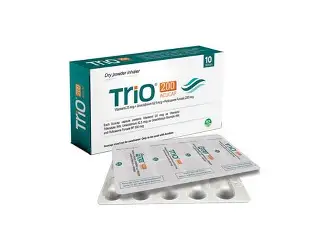
Trio Accucap 200mg Capsule
Made in:
Brand:
Capacity:

Authentic Product

Easy Return

Secure payments and fast deliveries
Indications This is indicated for- The maintenance treatment of patients with chronic obstructive pulmonary disease (COPD). The maintenance treatment of asthma in patients aged 18 years […]
Indications
- The maintenance treatment of patients with chronic obstructive pulmonary disease (COPD).
- The maintenance treatment of asthma in patients aged 18 years and older.
Limitation of use: Not indicated for relief of acute bronchospasm.
- Vilanterol 25 mcg (as Vilanterol Trifenatate INN), Fluticasone Furoate INN 100 mcg and Umeclidinium 62.5 mcg (as Umeclidinium Bromide INN).
- Vilanterol 25 mcg (as Vilanterol Trifenatate INN), Fluticasone Furoate INN 200 mcg and Umeclidinium 62.5 mcg (as Umeclidinium Bromide INN).
The precise mechanism through which futicasone furoate afects COPD and asthma symptoms is not known. Infammation is an important component in the pathogenesis of COPD and asthma. Corticosteroids have been shown to have a wide range of actions on multiple cell types (e.g., mast cells, eosinophils, neutrophils, macrophages, lymphocytes) and mediators (e.g., histamine, eicosanoids, leukotrienes, cytokines) involved in infammation.
Umeclidinium is a long-acting muscarinic antagonist, which is often referred to as an anticholinergic. It has similar afnity to the subtypes of muscarinic receptors M1 to M5 . In the airways, it exhibits pharmacological efects through inhibition of M3 receptor at the smooth muscle leading to bronchodilation.
Dosage & Administration
Adults (18 years or older): Should be used at the same time every day, not more than once every 24 hours. If shortness of breath or other asthma symptoms arise in the period between doses, an inhaled SABA (Short Acting β-Agonist) should be taken for immediate relief.
Maintenance treatment of COPD: 1 inhalation capsule once daily.
Maintenance treatment of Asthma: 1 inhalation capsule once daily.
Monoamine oxidase inhibitors and tricyclic antidepressants: Use with extreme caution. May potentiate the effect of vilanterol on the vascular system.
Beta-blockers: Use with caution. May block the bronchodilatory effects of beta-agonists and produce severe bronchospasm.
Diuretics: Use with caution. Electrocardiographic changes and/or hypokalemia associated with non–potassium-sparing diuretics may worsen with concomitant beta-agonists.
Anticholinergics: May interact additively with concomitantly used anticholinergic medications. Avoid administration of Trio with other anticholinergic-containing drugs.
- Primary treatment of status asthmaticus or acute episodes of COPD or asthma requiring intensive measures
- Severe hypersensitivity to milk proteins or any ingredients.
Asthma: Most common adverse reactions (incidence ≥2%) are pharyngitis/nasopharyngitis, upper respiratory tract infection/viral upper respiratory tract infection, bronchitis, respiratory tract infection/viral respiratory tract infection, sinusitis/acute sinusitis, urinary tract infection, rhinitis, infuenza, headache, and back pain.
Pregnancy & Lactation
Precautions & Warnings
- LABA monotherapy increases the risk of serious asthma-related events.
- Do not initiate in acutely deteriorating COPD or asthma. Do not use to treat acute symptoms.
- Do not use in combination with additional therapy containing a LABA because of risk of overdose.
- Candida albicans infection of the mouth and pharynx may occur. Monitor patients periodically. Advise the patient to rinse his/her mouth with water without swallowing after inhalation to help reduce the risk.
- Increased risk of pneumonia in patients with COPD. Monitor patients for signs and symptoms of pneumonia.
- If paradoxical bronchospasm occurs, discontinue and institute alternative therapy.
- Use with caution in patients with cardiovascular disorders because of beta-adrenergic stimulation.
- Worsening of urinary retention may occur. Use with caution in patients with prostatic hyperplasia or bladder-neck obstruction.
- Use with caution in patients with convulsive disorders, thyrotoxicosis, diabetes mellitus, and ketoacidosis.
Use in Special Populations
Elderly population: Based on available data, no adjustment of the dosage in geriatric patients is necessary, but greater sensitivity in some older individuals cannot be ruled out.
Renal impairment: It has not been studied in subjects with renal impairment.
Hepatic impairment: It has not been studied in subjects with hepatic impairment.
Overdose Effects
Therapeutic Class
Storage Conditions
| Capacity | 10 Tablets (1 Strip) |
|---|
Related products
৳ 20.80
- Capacity: 10 Tablets (1 Strip)
৳ 250.00
৳ 60.41
- Capacity: 10 Tablets (1 Strip)
৳ 80.00
- Capacity: 10 Tablets (1 Strip)
৳ 100.30




Reviews
There are no reviews yet.