


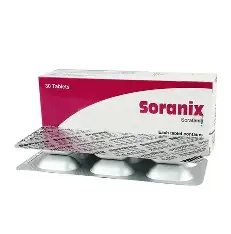
Soranix 200-MG Tablet
Made in:
Brand:
Capacity:

Authentic Product

Easy Return

Secure payments and fast deliveries
Indications Hepatocellular Carcinoma: Soranix is indicated for the treatment of patients with unresectable hepatocellular carcinoma (HCC). Renal Cell Carcinoma: Soranix is indicated for the treatment of […]
Indications
Renal Cell Carcinoma: Soranix is indicated for the treatment of patients with advanced renal cell carcinoma (RCC).
Dosage & Administration
Management of suspected adverse drug reactions may require temporary interruption and/or dose reduction of Sorafenib therapy. When dose reduction is necessary, the Sorafenib dose may be
reduced to 400 mg once daily. If additional dose reduction is required, Sorafenib may be reduced to a single 400 mg dose every other day.
Recommended regimens and treatment duration for Sorafenib therapy.
Grade 1: Numbness, dysesthesia, paresthesia, tingling, painless swelling, erythema or discomfort of the hands or feet which does not disrupt the patient’s:
- Any occurrence: Continue treatment with Sorafenib and consider topical therapy for symptomatic relief.
Grade 2: Painful erythema and swelling of the hands or feet and/ or discomfort affecting the patient’s normal activities
- 1st occurrence: Continue treatment with Sorafenib and consider topical therapy for symptomatic relief. If no improvement within 7 days, see below.
- No improvement within 7 days or 2nd or 3rd occurrence: Interrupt Sorafenib treatment until toxicity resolves to Grade 0-1 When resuming treatment, decrease Sorafenib dose by one dose level (400 mg daily or 400 mg every other day).
- 4th occurrence: Discontinue Sorafenib treatment.
Grade 3: Moist desquamation, ulceration, blistering or severe pain of the hands or feet, or severe discomfort that causes the patient to be unable to work or perform activities of daily living:
- 1st or 2nd occurrence: Interrupt Sorafenib treatment until toxicity resolves to Grade 0-1 When resuming treatment, decrease Sorafenib dose by one dose level (400 mg daily or 400 mg every other day).
- 3rd occurrence: Discontinue Sorafenib treatment.
No dose adjustment is required on the basis of patient age, gender, or body weight.
Missed doses: If a dose of Sorafenib is missed, skip the missed dose, and take next dose at regular time. Do not double your dose of Sorafenib.
Interaction
UGT1A1 and UGT1A9 Substrates: Systemic exposure to substrates of UGT1A1 and UGT1A9 may increase when co-administered with Soranix
Docetaxel: Concomitant use of Docetaxel (75 or 100 mg/m2 administered every 21 days) with Soranix (200 or 400 mg twice daily), administered with a 3-day break in dosing around administration of Docetaxel, resulted in a 36-80% increase in Docetaxel AUC and a 16-32% increase in Docetaxel Cmax. Caution is recommended when Soranix is co-administered with Docetaxel
Doxorubicin: Concomitant treatment with Soranix resulted in a 21% increase in the AUC of Doxorubicin. Caution is recommended when administering Doxorubicin with Soranix.
Fluorouracil: Both increases (21%-47%) and decreases (10%) in the AUC of Fluorouracil were observed with concomitant treatment with Soranix. Caution is recommended when Soranix is co-administered with Fluorouracil/Leucovorin.
CYP2B6 and CYP2C8 Substrates: Systemic exposure to substrates of CYP2B6 and CYP2C8 is expected to increase when co-administered with Soranix.
CYP3A4 Inducers: Continuous concomitant administration of Soranix and Rifampicin resulted in an average 37% reduction of Soranix AUC. Other inducers of CYP3A4 activity (for example, Hypericum perforatum also known as St. John’s wort, Phenytoin, Carbamazepine, Phenobarbital, and Dexamethasone) may also increase metabolism of Soranix and thus decrease Soranix concentrations.
CYP3A4 Inhibitors and CYP Isoform Substrates: Soranix metabolism is unlikely to be altered by CYP3A4 inhibitors and is unlikely to alter the metabolism of substrates of these enzymes.
P-glycoprotein Substrates: Soranix is an inhibitor of P-glycoprotein in vitro, therefore may increase the concentrations of concomitant drugs that are P-glycoprotein substrates.
CYP Enzyme Induction: CYP1A2 and CYP3A4 activities were not altered after treatment of cultured human hepatocytes with Soranix, indicating that Soranix is unlikely to be an inducer of CYP1A2 or CYP3A4.
Combination with other Antineoplastic Agents: Soranix had no effect on the pharmacokinetics of gemcitabine or oxaliplatin.
Neomycin: Coadministration of Soranix with oral Neomycin should be carefully considered because average plasma exposure (AUC) of Soranix was decreased by 54%.
Contraindications
Side Effects
Pregnancy & Lactation
Precautions & Warnings
Risk of Hemorrhage: An increased risk of bleeding may occur following Soranix administration. There was one fatal hemorrhage in each treatment group in RCC Study. If any bleeding necessitates medical intervention, permanent discontinuation of Soranix should be considered.
Risk of Hypertension: In the HCC study, hypertension was reported in approximately 9.4% and In RCC Study, hypertension was reported in approximately 16.9% of Soranix -treated patients. In cases of severe or persistent hypertension, despite institution of antihypertensive therapy, temporary or permanent discontinuation of Soranix should be considered.
Risk of Dermatologic Toxicities: Hand-foot skin reaction and rash represent the most common adverse reactions attributed to Soranix.
Risk of Gastrointestinal Perforation: In the event of a gastrointestinal perforation, Soranix therapy should be discontinued.
Warfarin Co-Administration: Patients taking concomitant warfarin should be monitored regularly for changes in prothrombin time, INR or clinical bleeding episodes.
Wound Healing Complications: Resume Soranix therapy following a major surgical intervention should be based on clinical judgment of adequate wound healing.
Use of Soranix in combination with Carboplatin and Paclitaxel in Non-small Cell Lung Cancer: Patients with squamous cell carcinoma (prospectively stratified), higher mortality was observed with the addition of Soranix compared to those treated with carboplatin and paclitaxel alone.
Interactions with UGT1A1 Substrates: Soranix can cause increases in plasma concentrations of drugs that are substrates of UGT1A1.
Interaction with Docetaxel & Doxorubicin: Soranix can cause increases in plasma concentrations of Docetaxel and Doxorubicin.
Hepatic Impairment: Hepatic impairment may reduce plasma concentrations of Soranix.
Neomycin: Co-administration of oral Neomycin causes a decrease in Soranix exposure.
Use in Special Populations
Geriatric Use: No differences in safety or efficacy were observed between older and younger patients
Renal impairment: No dose adjustment of Soranix is required for patients with any degree of renal impairment.
Hepatic impairment: Mild (Child-Pugh A) and moderate (Child-Pugh B) hepatic impairment have Soranix AUCs that may be 23 – 65% lower than subjects with normal hepatic function. Systemic exposure and safety data were comparable in HCC patients with Child-Pugh A and B hepatic impairment. Soranix has not been studied in patients with Child-Pugh C hepatic impairment.
Overdose Effects
Therapeutic Class
Storage Conditions
| Capacity | 1 Tablet ( 1 Strips ) |
|---|
Related products
- Capacity: 10 Tablets (1 Strip)
৳ 120.00
- Capacity: 10 Tablets (1 Strip)
৳ 280.00
- Capacity: 10 tablet ( 1strip )
৳ 30.10
- Capacity: 10 Tablets (1 Strip)
৳ 40.10
- Capacity: 10 Tablets (1 Strip)
৳ 125.00



Reviews
There are no reviews yet.