


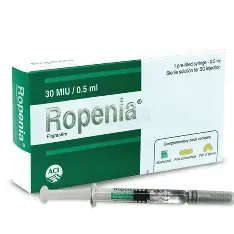
Ropenia IV/SC Injection 300mcg
Made in:
Brand:
Capacity:

Authentic Product

Easy Return

Secure payments and fast deliveries
Indications Cancer patients receiving myelosuppressive chemotherapy: The decrease of the incidence of infection, as manifested by febrile neutropenia, in patients with non myeloid malignancies receiving myelosuppressive […]
Indications
Cancer patients undergoing Acute Myeloid Leukemia: The reduction of the time to neutrophil recovery and the duration of fever, following induction or consolidation chemotherapy treatment of patients with acute myeloid leukemia (AML).
Cancer Patients Receiving Bone Marrow Transplantation (BMT): The reduction of the duration of neutropenia and neutropenia-related clinical sequelae, e.g., febrile neutropenia, in patients with nonmyeloid malignancies undergoing myeloablatlve chemotherapy followed by bone marrow transplantation.
Patients with severe chronic neutropenia: The reduction of the incidence and duration of sequelae of neutropenia (e.g., fever, infection or opharyngeal ulcers) in symptomatic patients with congenital neutropenia, cyclic neutropenia or idiopathic neutropenia.
Patients acutely exposed to myelosuppressive doses of radiation: The increase of the survival in patients acutely exposed to myelosuppressive doses of radiation (Hematopoietic syndrome of acute radiation syndrome).
Patients with HIV infection: The prevention and treatment of persistent neutropenia in patients with advanced HIV infection, in order to reduce the risk of bacterial infections, when other options to manage neutropenia are inappropriate.
Filgrastim exhibits nonlinear pharmacokinetics. Clearance is dependent on Filgrastim concentration and neutrophil count. Filgrastim is cleared by kidney. It has a tmax of 2 to 8 hours. The absolute bioavailability of Filgrastim after subcutaneous administration is 60-70%.
Dosage & Administration
Cancer patients undergoing bone marrow transplantation: The recommended dosage of Filgrastim following bone marrow transplantation (BMT) is 1.0 MU (10 mcg)/kg/day given as an intravenous infusion no longer than 24 hours. Administer the first dose of Filgrastim at least 24 hours after cytotoxic chemotherapy and at least 24 hours after bone marrow transplantation. Dose adjustment should be accordingly to absolute neutrophil count (ANC).
Patients undergoing autologous peripheral blood progenitor cell (PBPC) collection and therapy: The recommended dosage of Filgrastim for the mobilization of autologous PBPC is 1.0 MU (10 mcg)/kg/day given by subcutaneous injection for 5-7 days. Administer Filgrastim for at least 4 days before the first leukapheresis procedure and continue until the last leukapheresis. Discontinue Filgrastim if the white blood cell (WBC) count rises to greater than 100,000/mm³.
Patients with severe chronic neutropenia: The recommended starting dosage in patients with congenital neutropenia is 0.6 MU (6 mcg)/kg as a twice daily subcutaneous injection and with idiopathic or cyclic neutropenia is 0.5 MU (5 mcg)/kg as a single daily subcutaneous injection. Dose adjustment should be accordingly to ANC and complete blood count (CBC).
Patients acutely exposed to myelosuppressive doses of radiation hematopoietic syndrome of acute radiation syndrome: The recommended dose of Filgrastim is 1.0 MU (10 mcg)/kg as a single daily subcutaneous injection for patients exposed to myelosuppressive doses of radiation.
Patients with HIV infection: The recommended starting dose of Filgrastim is 0.1 MU (1.0 mcg)/kg/day is given daily by subcutaneous injection with titration up to a maximum of 0.4 MU (4 mcg) /kg/day until a normal neutrophil count is reached and can be maintained (ANC > 2.0 x 10 9 /I), Or, as directed by the register.
Interaction
Contraindications
Side Effects
- With nonmyeloid malignancies receiving myelosuppressive anti-cancer drugs are pyrexia, pain, rash, cough and dyspnea.
- With AML are pain, epistaxis and rash.
- With nonmyeloid malignancies undergoing myeloablative chemotherapy followed by BMT is rash.
- Undergoing peripheral blood progenitor cell mobilization and collection are bone pain, pyrexia and headache.
- With severe chronic neutropenia (SCN) are pain, anemia, epistaxis, diarrhea, hypoesthesia and alopecia.
Pregnancy & Lactation
Precautions & Warnings
- Ropenia should not be administered within 24 hours before and afier chemotherapy
- The possibility of Ropenia acting as a growth factor for any tumor type cannot be excluded
- To avoid -adverse effects of excessive neutrophils complete blood count is recommended twice per week during treatment
- Ropenia is given by subcutaneous or intravenous infusion as required
- Dilution of Ropenia conc less than 5 mcg/ml is not recommended at any time
- Ropenia may be diluted in 5% dextrose as required
Overdose Effects
Therapeutic Class
Storage Conditions
| Capacity | Injaction |
|---|
Related products
- Capacity: 10 Tablets (1 Strip)
৳ 100.30
- Capacity: 10 Tablets (1 Strip)
৳ 200.00
- Capacity: 10 Tablets (1 Strip)
৳ 350.00
- Capacity: 10 Tablets (1 Strip)
৳ 60.20
- Capacity: 10 Tablets (1 Strip)
৳ 250.00


Reviews
There are no reviews yet.