


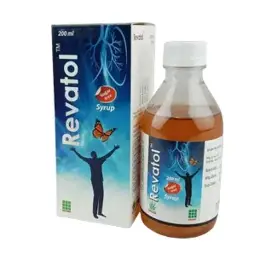
Revatol Syrup 200ML
Made in:
Brand:
Capacity:

Authentic Product

Easy Return

Secure payments and fast deliveries
Indications Chronic obstructive pulmonary diseases(COPD) Asthma (both allergic and cardiac asthma) Pulmonary fibrosis Pulmonary tuberculosis Composition Each 5 ml syrup contains extracts of- Vitis vinifera 0.72 […]
Indications
- Chronic obstructive pulmonary diseases(COPD)
- Asthma (both allergic and cardiac asthma)
- Pulmonary fibrosis
- Pulmonary tuberculosis
- Vitis vinifera 0.72 gm
- Cinnamomum zeylanicum 13.87 mg
- Elettaria cardamomum 13.87 mg
- Mesua ferrea 13.87 mg
- Aglaio roxburghiana 13.87 mg
- Saussurea lappa 13.87 mg
- Piper longum 13.87 mg
- Piper nigrum 13.87 mg
Description
Chemical constituents: The chemical analysis has shown the presence of proanthocyanidins (PCOs) including procyanidins, anthocyanins, flavanoids. 3-oxo-a-ionol, vomifoliol and dehydrovomifoliol were identified for the first time in fruit from Vitis vinifera. Therapeutically active constituent, resveratrol is isolated from the skin of Grapes.
Pharmacology
Resveratrol has several activities that may account for its possible cardioprotective action. These include inhibition of the oxidation of low-density lipoprotein (LDL), inhibition of smooth muscle cell proliferation and inhibition of platelet aggregation. Resveratrol also has been found to exert a strong inhibitory effect on superoxide anion and hydrogen peroxide production by macrophages stimulated by lipopolysaccharides or phorbol esters. It also increases nitric oxide and decreases lactate dehydrogenase levels in the carotid blood and effective against ischemia-reperfusion induced arrythmias. Triterpenes roxburghiadiol A and B isolated from this plant Aglaia roxburghiana has the potent anti-inflammatory activity and mast cell degranulation induced by A. roxburghiana extracts and the triterpenes.
Pharmacokinetics: From animal and limited human studies,it appears that resveratrol is absorbed from the gastrointestinal tract following its ingestion. Resveratrol is found in the form of a glucuronide conjugate after crossing the small intestine and entering the blood circulation. In case of human, five metabolites of resveratrolTiave been detected in urine, such as resveratrol monosulphate, two isomeric forms of resveratrol monoglucuronide, dihydroresveratrol monosulphate and dihydroresveratrol monoglucuronide. 56% sulphate and glucuronide conjugates excrete through urine (Baur and Sinclair,2006)
Dosage & Administration
- Children under 12 years: 1-2 teaspoonfuls (5-10 ml) 2 times daily after meal.
- Above 12 years and Adult: 3-4 teaspoonfuls (15-20 ml) 2 times daily after meal for 4-8 weeks or as directed by the physician.
Interaction
Side Effects
Pregnancy & Lactation
Precautions & Warnings
Therapeutic Class
Storage Conditions
| Capacity | 200ML |
|---|
Related products
- Capacity: 10 Tablets (1 Strip)
৳ 125.00
- Capacity: 10 Tablets (1 Strip)
৳ 350.00
- Capacity: 10 Tablets (1 Strip)
৳ 150.00
- Capacity: 10 Tablets (1 Strip)
৳ 450.00
- Capacity: 10 Tablets (1 Strip)
৳ 250.00


Reviews
There are no reviews yet.