


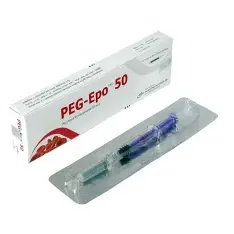
PEG-Epo IV/SC Injection
Made in:
Brand:
Capacity:

Authentic Product

Easy Return

Secure payments and fast deliveries
Indications PEG-Epo is indicated for the treatment of anemia associated with chronic kidney disease (CKD) in adult patients on dialysis and patients, not on dialysis. It […]
Indications
It is not indicated for use:
- In the treatment of anemia due to cancer chemotherapy.
- As a substitute for RBC transfusions in patients who require immediate correction of anemia.
Dosage & Administration
If the hemoglobin rises rapidly (e.g, more than 1 g/dL in any 2 week period), reduce the dose of Pegylated Erythropoietin by 25% or more as needed to reduce rapid responses. And for patients who do not respond adequately, if the hemoglobin has not increased by more than 1 g /dL after 4 weeks of therapy, increase the dose by 25%
For patients who do not respond adequately over a 12 week escalation period, increasing the Pegylated Erythropoietin dose further is unlikely to improve response and may increase risks
For patients with CKD on dialysis:
- The recommended starting dose of Pegylated Erythropoietin for the treatment of anemia in adult CKD patients who are not currently treated with an ESA is 0.6 mcg/kg body weight administered as a single IV or SC injection once every two weeks.
- Once the hemoglobin has been stabilized, it may be administered once monthly using a dose that is twice that of the every two-week dose and subsequently titrated as necessary.
For patients with CKD not on dialysis:
- The recommended starting dose of Pegylated erythropoietin for the treatment of anemia in adult CKD patients who are not currently treated with an ESA is 0.6 mcg/kg body weight administered as a single IV or SC injection once every two weeks.
- Once the hemoglobin has been stabilized, it may be administered once monthly using a dose that is twice that of the every two-week dose and subsequently titrated as necessary.
- Conversion from another ESA to Pegylated erythropoietin: It can be administered once every two weeks or once monthly to patients whose hemoglobin has been stabilized by treatment with an ESA.
- Increased Mortality, Myocardial Infarction, Stroke, and Thromboembolism
- Increased mortality and/or tumor progression in patients with cancer
- Hypertension
- Seizures
- Pure red cell aplasia
- Serious allergic reactions
Pregnancy & Lactation
Evaluation of Iron stores: Supplementary iron therapy is recommended for all patients with serum ferritin values below 100 mcg/L or with transferrin saturation below 20%. To ensure effective erythropoiesis, iron status has to be evaluated for all patients prior to and during treatment.
Precautions & Warnings
- Using ESA to target a hemoglobin level of >11 g/dL increase the rate of serious adverse cardiovascular reactions. It should be used with caution in patients with co-existant cardiovascular disease, stroke, seizure etc.
- Control hypertension prior to initiating of and during treatment with it
- Monitoring of patients for the change in seizure frequency or premonitory symptoms.
- If severe anemia and low reticulocyte count develop during the treatment, withhold it and evaluate patients for neutralizing antibodies to erythropoietin
Overdose Effects
Therapeutic Class
Storage Conditions
| Capacity | Injaction |
|---|
Related products
- Capacity: 10 tablet ( 1strip )
৳ 120.40
- Capacity: 10 Tablets (1 Strip)
৳ 80.00
- Capacity: 10 Tablets (1 Strip)
৳ 280.00
- Capacity: 10 Tablets (1 Strip)
৳ 100.30
- Capacity: 10 Tablets (1 Strip)
৳ 250.00



Reviews
There are no reviews yet.