


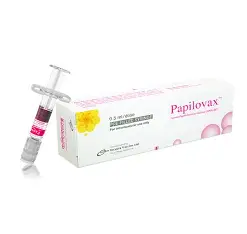
Papilovax IM Injection
Made in:
Brand:
Capacity:

Authentic Product

Easy Return

Secure payments and fast deliveries
Indications Papilovax is indicated for women aged 9-45 years. It is used for preventing the following diseases caused by oncogenic human papillomavirus (HPV) types 16 and/or […]
Indications
- Cervical cancer
- Cervical intraepithelial neoplasia Grade 2 or 3 (CIN2/3) and adenocarcinoma in-situ (AIS)
- Cervical intraepithelial neoplasia Grade 1 (CIN1) and persistent infections of HPV types 16 and/or 18
The risk of exposure to HPV increases with age, especially with sexual debut. Therefore, it is recommended to vaccinate as early as possible. It would be more beneficial to receive the vaccine at the earlier time between ages 9-45 years.
- Recombinant human papillomavirus type 16 L1 protein 40 µg
- Recombinant human papillomavirus type 18 L1 protein 20 µg
This is a mixture of two-aluminum hydroxide adjuvant-absorbed recombinant L1 capsid proteins of human papillomavirus (HPV) type-16 and type-18 each self-assembled into virus-like particles (VLPs). The HPV-16 and HPV-18 L1 antigens are expressed in Escherichia coli by recombinant DNA technology.
Description
Excipients: Aluminum hydroxide, Sodium dihydrogen phosphate, Disodium hydrogen phosphate, Sodium chloride, Polysorbate 80 & Water for injection.
- Immunization consists of 3 doses of 0.5-ml each, by intramuscular injection according to the following schedule: 0, 1, and 6 months. The preferred site of administration is the deltoid region of the upper arm.
- There has been no data on subcutaneous injection. Intravascular or intradermal injection is prohibited
- The content of the prefilled syringe should be inspected visually both before and after shaking for any foreign particulate matter and/or abnormal physical appearance prior to administration. In the event of either being observed, discard the vaccine.
- The vaccine should be shaken well before use, and it should be a white homogeneous suspension after shaking.
- It should be vaccinated as soon as possible after removal from the refrigeration container.
- The full-recommended dose of the vaccine should be used.
- Any prefilled syringe with crack, label unclear or invalid and vaccine with abnormal appearance should not be used.
Administration
- There are no data to assess the concomitant use of HPV vaccine with other vaccines. Do not mix it with any other vaccine in the same syringe or vial.
- Immunosuppressive therapies, including irradiation, antimetabolites, alkylating agents, cytotoxic drugs, and corticosteroids (used in greater than physiologic doses), may reduce the immune response to Human papillomavirus bivalent (Types 16 and 18) vaccine.
- The use of immunoglobulin or blood products should be avoided within 3 months prior to the vaccination of HPV vaccine.
- There has been no clinical evidence available to demonstrate whether the use of hormonal contraceptives will affect the preventive effect of HPV vaccine.
- Like other vaccines, vaccination of HPV vaccine in immunocompromised people may not induce adequate immune response. Concomitant use with immunosuppressive agents may not induce an optimal active immune response.
- At present, there has been no clinical data available to support the interchangeable use among HPV vaccines.
- The injection of HPV vaccine combined with other medicinal products is prohibited.
Interaction
Contraindications
Side Effects
Systemic Adverse Reactions:
- Very common: Fever (≥37.1°C)
- Common: Headache, fatigue, cough, muscle pain, nausea, diarrhea, dizziness and vomiting
- Occasional: Hypersensitivity, allergic dermatitis, rash, dizziness and pruritus.
Local Adverse Reactions:
- Very common: Pain at the injection site
- Common: Pruritus, induration, swelling and erythema at injection site
- Occasional: Rash and discomfort at injection site.
Most of the above adverse reactions are mild to moderate
Pregnancy & Lactation
Lactation: There has been no relevant study data to HPV vaccine. As many drugs can be secreted in breast milk, HPV vaccine should be used with caution in lactating women.
Precautions & Warnings
Prior to the vaccination, medical personnel should inquire and review the vaccinee’s medical history (especially the prior vaccination history and any prior adverse reaction related to vaccination), and conduct clinical examination to evaluate the benefits and risks of vaccination.
It is not recommended for populations other than those described in of the package insert.
Like other vaccines for injection, appropriate medical emergency measures and monitoring methods should be prepared to ensure that those who develop allergic reactions after the injection
Syncope (fainting) may occur after any dose of vaccine, leading to falls and injuries, especially in adolescents and young adults. Therefore, it is recommended that the observation on site be conducted for at least 30 minutes after each injection as required in the vaccination procedures.
It has been reported that syncope associated with tonic-clonic seizures and other epileptiform seizures may occur after the vaccination with similar products overseas. Syncope associated with tonic-clonic seizures is usually transient, and it can be resolved spontaneously when the vaccinee is placed in a supine or head-down position and the cerebral perfusion is restored. Some vaccinees may experience psychogenic reactions before/after the vaccination, and measures should be taken to avoid injury from the syncope.
Like other vaccines, the vaccination should be postponed in vaccinees with acute serious febrile illness. In case of current or recent fever symptoms, whether to postpone the vaccination depends mainly on the severity of the symptoms and their etiology. Low-grade fever and mild upper respiratory tract infection are not absolute contraindications to vaccination.
The vaccine should be used with caution in vaccinees with thrombocytopenia or any coagulation disorder.
Like any other vaccine, vaccination with HPV vaccine may not ensure the protective effect for all vaccinees.
It is only used for preventive purposes, but not indicated for the treatment of existing HPV-related lesions or preventing the progression of lesions.
It cannot prevent lesions caused by all high-risk types HPV infections. It has not been proved that it can prevent the lesions caused by the infection of non-vaccine types of HPV as well as the diseases not caused by HPV infection.
There has been no data on the use of HPV vaccine in vaccinees with impaired immune system (such as receiving the medication of immunosuppressive agents). Like other vaccines, vaccination in immunocompromised people may not induce adequate immune response.
Storage Conditions
| Capacity | Vaccine |
|---|
Related products
- Capacity: 10 Tablets (1 Strip)
৳ 80.00
- Capacity: 10 Tablets (1 Strip)
৳ 250.00
- Capacity: 10 Tablets (1 Strip)
৳ 350.00
- Capacity: 10 Tablets (1 Strip)
৳ 500.00
- Capacity: 10 Tablets (1 Strip)
Original price was: ৳ 12.00.৳ 11.00Current price is: ৳ 11.00.


Reviews
There are no reviews yet.