


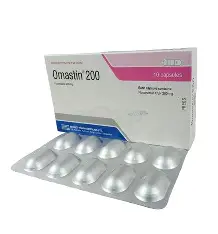
Omastin 200MG Capsule
Made in:
Brand:
Capacity:

Authentic Product

Easy Return

Secure payments and fast deliveries
Indications Omastin is indicated in- Vaginal Candidiasis Oropharyngeal Candidiasis Esophageal Candidiasis Tinea corporis/Tinea cruris/Tinea pedis/Other Tinea Kerion Pityriasis versicolor Onychomycosis Invasive candidal infections and cryptococcal infections […]
Indications
-
- Vaginal Candidiasis
- Oropharyngeal Candidiasis
- Esophageal Candidiasis
- Tinea corporis/Tinea cruris/Tinea pedis/Other Tinea
- Kerion
- Pityriasis versicolor
- Onychomycosis
- Invasive candidal infections and cryptococcal infections (including meningitis
- Vaginal Candidiasis: 150 mg as a single dose.
- Oropharyngeal Candidiasis: 200 mg in 1st day followed by 100 mg daily for 14 days.
- Oesophageal Candidiasis: 200 mg in 1st day followed by 100 mg daily for 14-30 days.
- Tinea corporis/Tinea cruris/Tinea pedis/Other Tinea: 150 mg weekly for 4-6 weeks.
- Kerion: 50 mg daily for 20 days.
- Pityriasis versicolor: 400 mg as a single dose.
- Onychomycosis: 150 mg weekly for 12 months.
- Invasive candidal infections and cryptococcal infections (including meningitis): Orally or by IV infusion, 400 mg on first day then 200-400 mg daily.
- Prevention of cryptococcal meningitis: Orally or by IV infusion 200 mg daily.
- Prevention of fungal infections in immunocompromised patients: Orally or by IV infusion, 50-400 mg daily.
Child over 1 year-
- In Superficial Candidiasis: 1-2 mg/kg daily.
- In Systemic Candidiasis & Cryptococcal infection:3-6 mg/kg daily.
In serious life threatening infections upto 12 mg/kg daily has been given to children aged 5-13 years (Maximum 400 mg daily)
- 1 year: 9 kg: 1/2 measuring spoonful
- 1-2 years: 12 kg: 1 measuring spoonful
- 2-3 years: 14 kg: 1½ measuring spoonful
- 3-4 years: 16 kg: 2 measuring spoonful
- 4-6 years: 20 kg: 2½ measuring spoonful
Use in Specific Population-
Elderly patient: The normal dose should be used if there is no evidence of renal impairment.
Renal Impairment: No adjustment in single dose therapy is required. In multiple dose therapy of patients with renal impairment, normal doses should be given on days 1 and 2 of treatment and there after the dosage intervals should be modified as follows:
- Creatinine clearance (>41 ml/min): Dosage interval (hours) 24
- Creatinine clearance (21-40 ml/min): Dosage interval (hours) 48
- Creatinine clearance (10-20 ml/min): Dosage interval (hours) 72
- Patients receiving regular dialysis: One dose after every dialysis session
Children: Renal clearance in children may be proportionately more rapid than in adults and doses up to 12 mg/kg is recommended.
Omastin has been shown to prolong the serum half-life of concomitantly administed oral sulphonyl ureas (chlorpropamide, gilbenclamide, glipizide and tolbutamide) in healthy volunteers. Omastin and oral sulphonylureas may be co-administered to diabetic patients, but the possibility of a hypoglycemic episode should be borne in mind.
In a kinetic interaction study, co-administration of multiple-dose hydrochlorothiazide to healthy volunteers receiving fuconazole increased plasma concentrations of fuconazole by 40%. An efect of this magnitude should not necessitate a change in the fuconazole dose regimen in subjects recieving concomitant diureties, although the prescribers should bear it in mind.
Concomitant administration of fuconazole and phenytoin may increase the level of phenytoin to a clinically signifcant degree. Administration of fuconazole and rifampicin has resulted in a 25% decrease in the AUC and 20% shorter half-life of fuconazole. Patients recieving concomitant rifampicin, an increase in the fuconazole dose should be considered.
Two kinetic studies with combined oral contraceptive have been performed using muitiple dose of fuconazole. There were no relevant efects on either hormone level in the 50 mg fuconazole study, while at 200 mg daily the AUCs of ethinyl estradiol and levonorgestrel were increased 40% and 4% respectively. Thus multipule dose use of fuconazole at these dose is unlikely to have an efect on the efcacy of the combined oral contraceptives. Omastin 50 mg daily does not afect endogenous steroid levels in females. 200-400 mg daily has no clinically singnifcant efect on endogenous steroid levels or on ACTH stimulated response in healthy male volunteers.
A kinetic study in renal transplant patients found fuconazole 200 mg daily to slowly increase cyclosporin concentrations. However, in another multiple dose study with 100 mg daily, fuconazole did not afect cyclosporin levels in patients with bone marrow transplants. Cyclosporin plasma concentration monitoring in patients receiving fuconazole is recommended.
Interaction studies have shown that when oral fuconazole is co-administered with food. cemetidine, antacids or following total body irradiation for bone marrow transplantation, no clinically signifcant impairment of fuconazole absorption occurs.
In placebo-controlled interaction study, the administration of fuconazole 200mg for 14 days resulted in an 18% decrease, in the mean plasma clearance of theophyline, Patients who are receiving dose of theophyline or who are otherwise at increased risk for theophyline toxicity should be observed for sign of toxicity while receiving fuconazole, and the therapy modifed appropriately if sign of toxicity while receiving fuconazole, and the therapy modifed appropriately if sign of toxicity develop.
Physicians should be aware that drug-drug interaction studies with other medications have not been conducted, but that such interactions may occur.
Contraindications
Pregnancy & Lactation
Precautions & Warnings
Very rarely. patients who died with severe underlying disease and who had received multiple dose fuconazole, had post-mortem fndings which included hapatic necrosis. These patients were receiving multiple concomitant medications, some known to be potentially hepatotoxic, and/or had underlying diseases, which could have caused the hepatic necrosis. Consequently, because a causal relationship with fuconazole cannot be excluded, the risk-beneft ratio of continued fuconazole treatment should be assessed in those patients in whom a signifcant rise of liver enzymes occurs.
Patients have rarely developed exfoliative cutaneous reactions, such pa Stevens Johnson Syndrome and toxic epidermal necrolysis, during treatment with fuconazole. AIDS patients are more prone to the development of severe cutaneous reactions to many drugs.
If a rash develops in a patients treated for a superfaclal fungal infection which is considered attributable to fuconazole further therapy with this agent should be discontinued. In patients with invasive/ systemic fungal infections who develop rashes, they should be monitored closely and fuconazole should be discontinued if bolbous lesions or erythema multiform develop.
Use during lactation: Omastin is found in human breast milk at concentrations similar to plasma. hence its use in nursing mothers is not recommended.
Driving/Use of machinery: Experience with fuconazole indicates that therapy a unlikely to impair a patient’s ability to drive or use machinery.
Use in Special Populations
Use in renal impairment: Omastin is excreted predominantly in the urine as unchanged drug. No adjustments in single dose therapy are required. In multiple dose therapy of patients with renal impairment, normal dose should be given on days 1 and 2 of treatment and thereafter the dosage intervals or daily dosage should be modifed in accordance with creatinine clearance as follows.
- CrCl >40: Dosage interval 24 hours (normal dosage regimen)
- CrCl 21-40: Dosage interval 48 hours or half normal daily dose
- CrCl 10-20: Dosage interval 72 hours or one-third normal daily dose
- Patients receiving regular haemodialysis: One dose after every dialysis session
Overdose Effects
Therapeutic Class
Storage Conditions
| Capacity | 10 Tablets ( 1Strips ) |
|---|
Related products
- Capacity: 10 Tablets (1 Strip)
৳ 50.20
৳ 60.41
- Capacity: 10 Tablets (1 Strip)
৳ 120.00
- Capacity: 10 Tablets (1 Strip)
৳ 450.00
- Capacity: 10 Tablets (1 Strip)
৳ 250.00


Reviews
There are no reviews yet.