


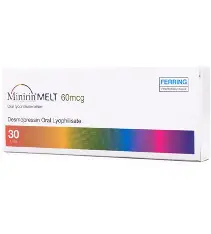
Minirin Melt 60-mcg Sublingual Tablet
Made in:
Brand:
Capacity:

Authentic Product

Easy Return

Secure payments and fast deliveries
Indications Minirin Melt film coated tablets are indicated as antidiuretic replacement therapy in the management of central diabetes insipidus and for the management of the temporary […]
Indications
Minirin Melt sublingual tablet is indicated for the treatment of-
- Primary Nocturnal Enuresis
- Nocturia and
- Central Diabetes Insipidus
Upon binding of desmopressin to V2 receptors in the basolateral membrane of the cells of the distal tubule and collecting ducts of the nephron, adenylyl cyclase is stimulated. The resulting intracellular cascades in the collecting duct lead to increased rate of insertion of water channels, called aquaporins, into the lumenal membrane and enhanced the permeability of the membrane to water.
Dosage & Administration
- Treatment of diabetes insipidus: Dosage is individual in diabetes insipidus but the total daily sublingual dose normally lies in the range of 120 micrograms to 720 micrograms. A suitable starting dose in adults and children is 60 micrograms three times daily, administered sublingually. This dosage regimen should then be adjusted in accordance with the patient’s response. For the majority of patients, the maintenance dose is 60 micrograms to 120 micrograms sublingually three times daily.
- Post-hypophysectomy polyuria/polydipsia: The dose of Desmopressin Acetate Melt should be controlled by measurement of urine osmolality.
Film coated tablet:
- Adults and Children: It is recommended that patients be started on doses of 0.05 mg (1/2 of the 0.1 mg tablet) two times a day and individually adjusted to their optimum therapeutic dose. Most patients in clinical trials found that the optimal dosage range is 0.1 mg to 0.8 mg daily, administered in divided doses. Each dose should be separately adjusted for an adequate diurnal rhythm of water turnover. Total daily dosage should be increased or decreased in the range of 0.1 mg to 1.2 mg divided into two or three daily doses as needed to obtain adequate antidiuresis.
- Geriatric Use: This drug is known to be substantially excreted by the kidney, and the risk of toxic reactions to this drug may be greater in patients with impaired renal function. Because elderly patients are more likely to have decreased renal function, care should be taken in dose selection, and it may be useful to monitor renal function.
Interaction
Contraindications
Side Effects
Pregnancy & Lactation
Precautions & Warnings
Intranasal formulations of Minirin Melt at high doses and Minirin Melt Injection have infrequently produced a slight elevation of blood pressure which disappears with a reduction of dosage. Although this effect has not been observed when single oral doses up to 0.6 mg have been administered, the drug should be used with caution in patients with coronary artery insufficiency and/or hypertensive cardiovascular disease, because of a possible rise in blood pressure.
Therapeutic Class
Storage Conditions
| Capacity | 10 Tablets ( 1Strips ) |
|---|
Related products
- Capacity: 10 Tablets (1 Strip)
৳ 250.00
- Capacity: 10 Tablets (1 Strip)
৳ 350.00
- Capacity: 10 Tablets (1 Strip)
৳ 280.00
- Capacity: 10 Tablets (1 Strip)
৳ 125.00
- Capacity: 10 Tablets (1 Strip)
৳ 80.00



Reviews
There are no reviews yet.