


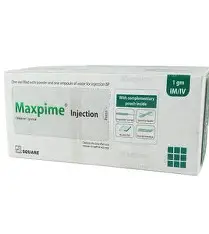
Maxpime IM/IV Injection 1GM
Made in:
Brand:
Capacity:

Authentic Product

Easy Return

Secure payments and fast deliveries
Indications Maxpime is indicated for the treatment of the following infections caused by susceptible strains of the microorganisms: Pneumonia (moderate to severe): caused by Streptococcus pneumoniae, […]
Indications
- Pneumonia (moderate to severe): caused by Streptococcus pneumoniae, including cases associated with concurrent bacteremia, Pseudomonas aeruginosa, Klebsiella pneumoniae, or Enterobacter species.
- Febrile Neutropenia: Maxpime as monotherapy is indicated for empiric treatment of febrile neutropenic patients. In patients at high risk for severe infection (including patients with a history of recent bone marrow transplantation, with hypotension at presentation, with an underlying hematologic malignancy, or with severe or prolonged neutropenia), antimicrobial monotherapy may not be appropriate. Insufficient data exist to support the efficacy of cefepime monotherapy in such patients.
- Uncomplicated and Complicated Urinary Tract Infections (including pyelonephritis): caused by Escherichia coli or Klebsiella pneumoniae, when the infection is severe, or caused by Escherichia coli, Klebsiella pneumoniae, or Proteus mirabilis, when the infection is mild to moderate, including cases associated with concurrent bacteremia with these microorganisms.
- Uncomplicated Skin and Skin Structure Infections: caused by Staphylococcus aureus (methicillin- susceptible strains only) or Streptococcus pyogenes.
- Complicated Intra-abdominal Infections (used in combination with metronidazole): caused by Escherichia coli, viridians group streptococci, Pseudomonas aeruginosa, Klebsiella pneumoniae, Enterobacter species, or Bacteroides fragilis.
Dosage & Administration
- Moderate to Severe Pneumonia due to S. pneumoniae, *P. aeruginosa, K. pneumoniae, or Enterobacter species: 1-2 gm IV 12 hourly for 10 days.
- Empiric therapy for febrile neutropenic patients: 2 gm IV 8 hourly for 7** days.
- Mild to Moderate Uncomplicated or Complicated Urinary Tract Infections, including pyelonephritis, due to E. coli, K. pneumoniae, or P. mirabilis*: 0.5-1 gm IV/IM*** 12 hourly for 7-10 days.
- Severe Uncomplicated or Complicated Urinary Tract Infections, including pyelonephritis, due to E. coli or K. pneumoniae*: 2 gm IV 12 hourly for 10 days.
- Moderate to Severe Uncomplicated Skin and Skin Structure Infections due to S. aureus or S. pyogenes: 2 gm IV 12 hourly for 10 days.
- Complicated Intra-abdominal Infections (used in combination with metronidazole) caused by E. coli, viridans group streptococci, P. aeruginosa, K. pneumoniae, Enterobacter species, or B. fragilis: 2 gm IV 12 hourly for 7-10 days.
Note:
*including cases associated with concurrent bacteremia.
**or until resolution of neutropenia. In patients whose fever resolves but who remain neutropenic for more than 7 days, the need for continued antimicrobial therapy should be re evaluated frequently.
*** IM route of administration is indicated only for mild to moderate, uncomplicated or complicated UTls due to E. coli when the IM route is considered to be a more appropriate route of drug administration.
Interaction
Contraindications
Side Effects
Pregnancy & Lactation
Precautions & Warnings
- Prescribing Maxpime in the absence of a proven or strongly suspected bacterial infection or a prophylactic indication is unlikely to provide benefit to the patient and increases the risk of the development of drug-resistant bacteria.
- As with other antimicrobials, prolonged use of Maxpime may result in overgrowth of non susceptible microorganisms. Repeated evaluation of the patient’s condition is essential.
- Many cephalosporins, including cefepime, have been associated with a fall in prothrombin activity. Those at risk include patients with renal or hepatic impairment, or poor nutritional state, as well as patients receiving a protracted course of antimicrobial therapy. Prothrombin time should be monitored in patients at risk.
- Maxpime should be prescribed with caution in individuals with a history of gastrointestinal disease, particularly colitis.
- Arginine has been shown to alter glucose metabolism and elevate serum potassium transiently when administered at 33 times the amount provided by the maximum recommended human dose of Maxpime. The effect of lower doses is not presently known.
Use in Special Populations
Geriatric Use: Serious adverse events have occurred in geriatric patients with renal insufficiency given unadjusted doses of cefepime, including life-threatening or fatal occurrences of the following: encephalopathy, myoclonus, and seizures. Maxpime is known to be substantially excreted by the kidney, and the risk of toxic reactions to Maxpime may be greater in patients with impaired renal function. Because elderly patients are more likely to have decreased renal function, care should be taken in dose selection, and renal function should be monitored.
Impaired Hepatic Function: No adjustment is necessary for patients with impaired hepatic function.
Impaired Renal Function: In patients with impaired renal function (creatinine clearance<60 ml/min), the dose of Maxpime should be adjusted to compensate for the slower rate of renal elimination.
Overdose Effects
Therapeutic Class
Reconstitution
Intravenous: Maxpime is compatible with Sterile Water for Injection. It is also compatible at concentrations between 1 mg/ml and 40 mg/ml with the following IV infusion fluids: 0.9% Sodium Chloride Injection, 5% and 10% Dextrose Injection, M/6 Sodium Lactate Injection, 5% Dextrose and 0.9% Sodium Chloride Injection, Lactated Ringers and 5% Dextrose Injection.
Intramuscular: Maxpime is compatible with the following diluent such as: Sterile Water for Injection, 0.9% Sodium Chloride Injection, 5% Dextrose Injection, Sterile Bacteriostatic Water for Injection with Parabens or Benzyl Alcohol or 0.5% or 1% Lidocaine Hydrochloride.
500 mg (IV) vials for intravenous administration:
- Amount of WFI to be added: 5 ml
- Approximate available volume: 5.6 ml
500 mg (IM) vials for intramuscular administration:
- Amount of WFI to be added: 1.3 ml
- Approximate available volume: 1.8 ml
1 gm (IV) vials for Intravenous administration:
- Amount of WFI to be added: 10 ml
- Approximate available volume: 11.3 ml
1 gm (IM) vials for intramuscular administration:
- Amount of WFI to be added: 2.4 ml
- Approximate available volume: 3.6 ml
2 gm (IV) vials for Intravenous administration:
- Amount of WFI to be added: 10 ml
- Approximate available volume: 12.5 ml
Storage Conditions
| Capacity | Injaction |
|---|
Related products
৳ 20.80
- Capacity: 10 Tablets (1 Strip)
৳ 120.00
- Capacity: 10 Tablets (1 Strip)
৳ 100.30
- Capacity: 10 Tablets (1 Strip)
৳ 150.00
- Capacity: 10 Tablets (1 Strip)
৳ 200.00


Reviews
There are no reviews yet.