


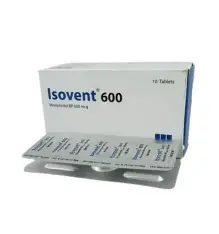
Isovent 600MG Tablets
Made in:
Brand:
Capacity:

Authentic Product

Easy Return

Secure payments and fast deliveries
Indications Isovent is indicated for- Prophylaxis of gastric and duodenal ulceration in NSAID users at high risk of complications from gastric ulcer e.g. the elderly, patients […]
Indications
- Prophylaxis of gastric and duodenal ulceration in NSAID users at high risk of complications from gastric ulcer e.g. the elderly, patients with concomitant debilitating disease and patients with a history of ulcer.
- Healing of established NSAID- induced gastric and duodenal damage.
- Healing of gastric and duodenal ulcers in the absence of NSAID therapy.
- Induction of labor.
- Prevention and treatment of postpartum hemorrhage.
Dosage & Administration
Prophylaxis of NSAID-induced gastric and duodenal ulcer: 200 mcg 2-4 times daily taken with NSAID. If this dose cannot be tolerated, a dose of 100 mcg can be used. Misoprostol should be taken for the duration of NSAID therapy as prescribed by the physician.
Induction of labor: Place 25 mcg in the posterior fornix of the vagina. Repeat after every 6 hours if necessary until the maximum dosage of 200 mcg total misoprostol is reached. Fetal heart rate and uterus contractions should be monitored. Alternatively, 100 mcg taken orally. If cervical ripening or active labor does not occur, repeated dose of 100-200 mcg of oral misoprostol is given every 4 hourly until labor is established (as evidenced by a Bishop score of 7 or more). Maximum number of dose is 6. Maternal vital signs, fetal heart rate and contractions should be monitored. Oxytocin can be started 4 hours after last dose of misoprostol. Physician should be notified for signs of fetal distress or tetanic uterine contractions. Oral misoprostol therapy should be monitored by Physician.
Prevention of postpartum hemorrhage: 600 mcg orally immediately following delivery.
Treatment of postpartum hemorrhage: 600 mcg orally or 1000 mcg per rectally.
Interaction
Contraindications
Side Effects
Pregnancy & Lactation
- has had a negative serum pregnancy test within 2 weeks prior to beginning therapy.
- is capable of complying with effective contraceptive measures.
- has received both oral and written warnings of the hazards of Misoprostol, the risk of possible contraception failure, and the danger to other women of childbearing potential should the drug be taken by mistake.
- will begin it only on the second or third day of the next normal menstrual period.
Excretion of the active metabolite (Misoprostol acid) into milk is possible but has not been studied. Because of the potential for serious adverse reactions in nursing infants, it is not recommended for use by nursing mothers.
Precautions & Warnings
In case of induction of labor: The pregnancy should have completed 38 weeks gestation by reliable dating, or lung maturity as evidenced by a L/S >2.0 or a positive phosphotidyl glycerol test, or completed 36 weeks gestation with a maternal or fetal medical indication for induction of labor. Induction of labor is contraindicated in acute fetal distress, abruptio placenta, placenta previa or unexplained vaginal bleeding. The fetus should be in vertex presentation.
Use in Special Populations
Overdose Effects
Therapeutic Class
Storage Conditions
| Capacity | 1 Tablet ( 1 Strips ) |
|---|
Related products
- Capacity: 10 Tablets (1 Strip)
৳ 250.00
- Capacity: 10 Tablets (1 Strip)
৳ 450.00
- Capacity: 10 Tablets (1 Strip)
৳ 30.10
- Capacity: 10 Tablets (1 Strip)
Original price was: ৳ 12.00.৳ 11.00Current price is: ৳ 11.00.
- Capacity: 10 Tablets (1 Strip)
৳ 200.00



Reviews
There are no reviews yet.