


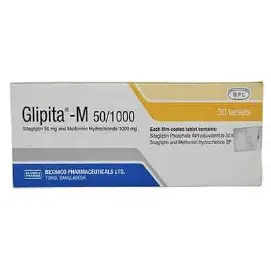
Glipita-M 50/1000MG Tablet
Made in:
Brand:
Capacity:

Authentic Product

Easy Return

Secure payments and fast deliveries
Indications This is indicated as an adjunct to diet and exercise to improve glycemic control in adults with type 2 diabetes mellitus when treatment with both […]
Indications
Important limitations of use:
-
- This should not be used in patients with type 1 diabetes or for the treatment of diabetic ketoacidosis, as it would not be efective in these settings
Dosage & Administration
This tablet should generally be given twice daily with meals, with gradual dose escalation, to reduce the gastrointestinal (GI) side efects due to metformin.
The starting dose of this tablet should be based on the patient’s current regimen. This tablet should be given twice daily with meals.
The recommended starting dose in patients not currently treated with metformin is 50 mg sitagliptin/500 mg metformin hydrochloride twice daily, with gradual dose escalation recommended to reduce gastrointestinal side efects associated with metformin.
The starting dose in patients already treated with metformin should provide sitagliptin dosed as 50 mg twice daily (100 mg total daily dose) and the dose of metformin already being taken. For patients taking metformin 850 mg twice daily, the recommended starting dose of this tablet is 50 mg sitagliptin/1000 mg metformin hydrochloride twice daily.
No studies have been performed specifcally examining the safety and efcacy of Sitagliptin Phosphate Monohydrate INN/Metformin Hydrochloride BP in patients previously treated with other oral antihyperglycemic agents and switched to Sitagliptin Phosphate Monohydrate INN/Metformin Hydrochloride BP. Any change in therapy of type 2 diabetes should be undertaken with care and appropriate monitoring as changes in glycemic control can occur.
Dose of extended-release tablet: Administer once daily with a meal preferably in the evening. Gradually escalate the dose to reduce the gastrointestinal side effects due to Metformin. May adjust the dosing based on effectiveness and tolerability while not exceeding the maximum recommended daily dose of 100 mg Sitagliptin and 2000 mg Metformin extended-release. Maintain the same total daily dose of Sitagliptin and Metformin when changing between film-coated tablet and extended-release tablet, without exceeding the maximum recommended daily dose of 2000 mg Metformin extended-release.
Patients using two extended-release tablets (such as two 50/500 or two 50/1000 tablets) should take the two tablets together once daily. The 100 mg Sitagliptin/1000 mg Metformin HCI extended-release tablet should be taken as a single tablet once daily.
Patients treated with an insulin secretagogue or insulin: Co-administration of the combination with an insulin secretagogue (e.g., sulfonylurea) or insulin may require lower doses of the insulin secretagogue or insulin to reduce the risk of hypoglycemia.
Interaction
Phenprocoumon: Metformin may decrease the anticoagulant effect of phenprocoumon. Therefore, close monitoring of the INR is recommended.
Levothyroxine: Levothyroxine can reduce the hypoglycemic effect of metformin. Monitoring of blood glucose levels is recommended, especially when thyroid hormone therapy is initiated or stopped, and the dosage of metformin must be adjusted if necessary.
Contraindications
- Renal disease or renal dysfunction, e.g., as suggested by serum creatinine levels ≥1.5 mg/dL [males], ≥1.4 mg/dL [females] or abnormal creatinine clearance which may also result from conditions such as cardiovascular collapse (shock), acute myocardial infarction, and septicemia
- Acute or chronic metabolic acidosis, including diabetic ketoacidosis, with or without coma.
- History of a serious hypersensitivity reaction to this tablet or sitagliptin, such as anaphylaxis or angioedema.
This tablet should be temporarily discontinued in patients undergoing radiologic studies involving intravascular administration of iodinated contrast materials, because use of such products may result in acute alteration of renal function.
Adverse reactions reported in ≥5% of patients treated with sitagliptin in combination with sulfonylurea and metformin and more commonly than in patients treated with placebo in combination with sulfonylurea and metformin were hypoglycemia and headache.
Hypoglycemia was the only adverse reaction reported in ≥5% of patients treated with sitagliptin in combination with insulin and metformin and more commonly than in patients treated with placebo in combination with insulin and metformin.
Nasopharyngitis was the only adverse reaction reported in ≥5% of patients treated with sitagliptin monotherapy and more commonly than in patients given placebo.
The most common (>5%) adverse reactions due to initiation of metformin therapy are diarrhea, nausea/vomiting, fatulence, abdominal discomfort, indigestion, asthenia, and headache.
Pregnancy & Lactation
It is not known whether sitagliptin is excreted in human milk. Because many drugs are excreted in human milk, caution should be exercised when this tablet is administered to a nursing woman.
Precautions & Warnings
- Lactic acidosis can occur due to metformin accumulation. The risk increases with conditions such as sepsis, dehydration, excess alcohol intake, hepatic insufciency, renal impairment, and acute congestive heart failure.
- Symptoms include malaise, myalgias, respiratory distress, increasing somnolence, and nonspecifc abdominal distress. Laboratory abnormalities include low pH, increased anion gap and elevated blood lactate.
- If acidosis is suspected, discontinue this tablet and hospitalize the patient immediately.
- Regular monitoring of thyroid-stimulating hormone (TSH) levels is recommended in patients with hypothyroidism.
- Long-term treatment with metformin has been associated with a decrease in vitamin B12 serum levels which may cause peripheral neuropathy. Monitoring of the vitamin B12 level is recommended.
Others-
- Do not use this tablet in patients with hepatic disease.
- There have been postmarketing reports of acute renal failure, sometimes requiring dialysis. Before initiating this tablet and at least annually thereafter, assess renal function and verify as normal.
- There have been postmarketing reports of acute pancreatitis, including fatal and non-fatal hemorrhagic or necrotizing pancreatitis. If pancreatitis is suspected, promptly discontinue this tablet.
- Measure hematologic parameters annually.
- Warn patients against excessive alcohol intake.
- May need to discontinue this tablet and temporarily use insulin during periods of stress and decreased intake of fluids and food as may occur with fever, trauma, infection or surgery.
- Promptly evaluate patients previously controlled on this tablet who develop laboratory abnormalities or clinical illness for evidence of ketoacidosis or lactic acidosis.
- When used with an insulin secretagogue (e.g., sulfonylurea) or with insulin, a lower dose of the insulin secretagogue or insulin may be required to reduce the risk of hypoglycemia.
- There have been postmarketing reports of serious allergic and hypersensitivity reactions in patients treated with sitagliptin (one of the components of this tablet ), such as anaphylaxis, angioedema, and exfoliative skin conditions including Stevens-Johnson syndrome. In such cases, promptly stop this tablet, assess for other potential causes, and institute appropriate monitoring and treatment, and initiate alternative treatment for diabetes.
- There have been no clinical studies establishing conclusive evidence of macrovascular risk reduction with Sitagliptin Phosphate Monohydrate INN/Metformin Hydrochloride BP or any other anti-diabetic drug.
Overdose Effects
Metformin hydrochloride: Overdose of metformin hydrochloride has occurred, including ingestion of amounts greater than 50 grams. Metformin is dialyzable with a clearance of up to 170 mL/min under good hemodynamic conditions. Therefore, hemodialysis may be useful for removal of accumulated drug from patients in whom metformin overdosage is suspected. Pancreatitis may occur in the context of a metformin overdose.
Therapeutic Class
Storage Conditions
| Capacity | 10 Tablets ( 1Strips ) |
|---|
Related products
- Capacity: 10 Tablets (1 Strip)
৳ 80.00
- Capacity: 10 Tablets (1 Strip)
৳ 500.00
- Capacity: 10 Tablets (1 Strip)
৳ 200.00
- Capacity: 10 Tablets (1 Strip)
৳ 200.00
- Capacity: 10 Tablets (1 Strip)
৳ 150.00



Reviews
There are no reviews yet.