


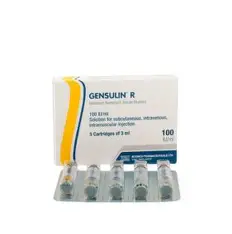
Gensulin R 3 ml cartridge
Made in:
Brand:
Capacity:

Authentic Product

Easy Return

Secure payments and fast deliveries
Indications Gensulin R Injection is indicated in- Treatment of all patients with type 1 diabetes Treatment of patients with type 2 diabetes who are not adequately controlled […]
Indications
- Treatment of all patients with type 1 diabetes
- Treatment of patients with type 2 diabetes who are not adequately controlled by diet and/ or oral hypoglycemic agents
- For the initial stabilization of diabetes in patients with diabetic ketoacidosis, hyperosmolar non-ketotic syndrome and during periods of stress such as severe infections and major surgery in diabetic patients
- Treatment of gestational diabetes.
Insulin Human R (100 IU/ml: Each ml solution contains Insulin Human (rDNA) USP 100 IU (equivalent to 3.47 mg) as Soluble Insulin Human (Regular).
Insulin Human N (40 IU/ml): Each ml suspension contains Insulin Human (rDNA) USP 40 IU (equivalent to 1.388 mg) as Isophane Insulin Human.
Insulin Human N (100 IU/ml): Each ml suspension contains Insulin Human (rDNA) USP 100 IU (equivalent to 3.47 mg) as Isophane Insulin Human.
Pharmacology
Insulin has a half-life of a few minutes in the blood stream. No profound binding to plasma proteins. An average action profile after subcutaneous injection indicates:
- Onset of action- within 30 minutes
- Peak plasma levels attained between 1-3 hours
- Duration of action- approximately 4-6 hours
Dosage
The average range of total daily insulin requirement for maintenance therapy in type 1 diabetic patients lies between 0.5 and 1.0 IU/Kg. In pre-pubertal children it usually varies from 0.7 to 1.0 IU/ Kg.
The daily insulin requirement may be higher in patients with insulin resistance (e.g. during puberty in the young or due to obesity) and lower in patients with endogenous insulin production or during the period of partial remission.
Initial dosage for type 2 diabetic patients are often lower, e.g. 0.3 to 0.6 IU/ Kg/ Day.
An injection should be followed within 30 minutes by a meal or snack containing carbohydrates.
Administration
- It is usually administered subcutaneously in the abdominal wall. The thigh, the gluteal region or the deltoid region may also be used.
- Subcutaneous injection into the abdominal wall ensures a faster absorption than from other injection sites.
- In order to avoid lipodystrophy, injection sites for a given insulin preparation should be rotated within an anatomic region.
- Intramuscular administrations are possible under guidance by a physician.
- Intravenous administrations should only be carried out by a physician.
Dosage Adjustment
- Concomitant illness, especially infections and feverish conditions, usually increases the patient’s insulin requirement.
- Renal or hepatic impairment may reduce insulin requirement.
- Adjustment of the dosage may also be necessary if patients change physical activity or their usual diet.
- Dosage adjustment may be necessary when transferring patients from one insulin preparation to another.
Interaction
The following substances may reduce the insulin requirements: Oral hypoglycaemic agents (OHA), monoamine oxidase inhibitors (MAOI), non-selective beta-blocking agents, angiotensin converting enzyme (ACE) inhibitors, salicylates and alcohol.
The following substances may increase the insulin requirements: Thiazides, glucocorticoids, thyroid hormones and beta-sympathomimetics, growth hormone and danazol.
Beta-blockers may mask the symptoms of hypoglycaemia and delay recovery from hypoglycaemia. Octreotide/lanreotide may both increase and decrease insulin requirement. Alcohol may intensify and prolong the hypoglycaemic effect of insulin.
Contraindications
Side Effects
Lipodystrophy may occur at the injection site as a consequence of failure to rotate injection sites within an area.
Symptoms of generalized hypersensitivity may include generalized skin rash, itching, sweating, gastrointestinal upset and angioneurotic oedema, difficulties in breathing, palpitation and reduction in blood pressure. Generalised hypersensitivity reactions are potentially life threatening.
Oedema may occur upon initiation of insulin therapy. These symptoms are usually of transitory nature.
Pregnancy & Lactation
Precautions & Warnings
Hypoglycaemia may occur if the insulin dose is too high in relation to the insulin requirement.
Transferring a patient to another type or brand of insulin should be done under strict medical supervision.
Changes in strength, brand (manufacturer), type (rapid acting insulin, dual acting insulin, intermediate and long acting insulin etc.), species (animal, human insulin analogue) and/or method of manufacture (recombinant DNA versus animal source insulin) may result in the need for a change in dosage.
Before travelling between different time zones, the patients should be advised to consult the doctor, since this may mean that the patients have to take insulin and meals at different time.
Overdose Effects
Mild hypoglycaemic episodes can be treated by oral administration of glucose or sugery products.
Severe hypoglycaemic episodes, where the patient has become unconscious, can be treated by glucagon (0.5 to 1 mg) given intramuscularly or subcutaneously by a trained person or glucose given intravenously by a medical professional. Glucose must also be given intravenously, if the patient does not respond to glucagon within 10 to 15 minutes.
Upon regaining consciousness administration of oral carbohydrate is recommended for the patient in order to prevent relapse.
Therapeutic Class
Storage Conditions
| Capacity | Insulin |
|---|
Related products
- Capacity: 10 Tablets (1 Strip)
৳ 80.00
- Capacity: 10 Tablets (1 Strip)
Original price was: ৳ 12.00.৳ 11.00Current price is: ৳ 11.00.
- Capacity: 10 Tablets (1 Strip)
৳ 150.00
- Capacity: 10 Tablets (1 Strip)
৳ 120.00
- Capacity: 10 Tablets (1 Strip)
৳ 500.00


Reviews
There are no reviews yet.