


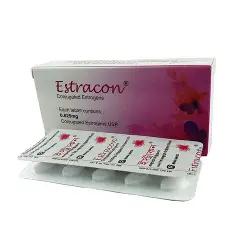
Estracon Tablet
Made in:
Brand:
Capacity:

Authentic Product

Easy Return

Secure payments and fast deliveries
Indications Estracon is indicated in- Moderate-to-severe vasomotor symptoms associated with estrogen deficiency. Prevention and management of osteoporosis associated with estrogen deficiency. Decrease of the risk of […]
Indications
- Moderate-to-severe vasomotor symptoms associated with estrogen deficiency.
- Prevention and management of osteoporosis associated with estrogen deficiency.
- Decrease of the risk of coronary heart disease and its associated mortality in postmenopausal women.
- Atrophic vaginitis and atrophic arthritis.
- Female hypoestrogenism.
Osteoporosis associated with estrogen deficiency: Estrogen replacement therapy is the most effective single modality for the prevention of osteoporosis (loss of bone mass) in postmenopausal women. Estrogen reduces bone resorption and retards or halts postmenopausal bone loss. Case-control studies have shown up to 60 percent reduction in hip and writs fractures in women whose estrogen replacement was begun within a few years of menopause. Studies also suggest that estrogen reduces the rate of vertebral fractures. One clinical study demonstrated that even when estrogen was started as late as fifteen years after menopause, further loss of bone mass was prevented but no restoration of bone mass was observed. The effect on bone mass conservation is sustained only as long as Estracon therapy is continued. Different ethnic groups are at different risk for osteoporosis.
Cardiovascular Benefit: Case-control, cohort and coronary angiography studies have been conducted investigating the association between postmenopausal oral estrogen therapy and cardiovascular disease. The majority of studies show a decreased risk of coronary heart disease in postmenopausal women taking estrogen replacement therapy. An analysis of the available data shows an overall decrease in the risk of coronary heart disease of approximately 50% in women treated with Estracon. In the majority of these studies Estracons were the predominant therapy. This beneficial effect appears to be related to several mechanisms of action including, but perhaps not limited to, beneficial effects on lipids and lipoproteins and direct effects on the coronary vessels. Although it has been reported that progestogen therapy may attenuate the beneficial effects of estrogen on lipids, the overall effect on coronary heart disease is unknown. Estracon should be used with other important measures such as dietary changes, exercise, and cessation of smoking to achieve optimal cardiovascular benefit.
Atrophic vaginitis and atrophic urethritis associated with estrogen deficiency: In the absence of estrogen stimulation, the vulvar and vaginal tissues shrink, the vaginal walls become thin and dry, and rugal folds disappear. Tenderness and pruritus, with resulting dysuria and dyspareunia, may occur. Fissures and ulcerations of tissue with spotting or bleeding may result from coitus. These changes are reversible with the administration of estrogen replacement therapy.
Female Hypoestrogenism: Estrogen replacement therapy is indicated in hypoestrogenism related to female hypogonadism or primary ovarian failure. Primary ovarian failure starting early in life will lead to delayed closure of the epiphyses and retarded bone maturation. Long term estrogen deficiency in any age group will usually lead to osteoporosis (for efficacy with estrogen replacement therapy see osteoporosis). Estrogen therapy is associated with the appearance of female characteristics in these patients.
Pharmacology
Estrogens are important in the development and maintenance of the female urogenital system and secondary sex characteristics. They promote growth and development of the vagina, uterus, and fallopian tubes, and enlargement of the breasts. Indirectly, they contribute to the shaping of the skeleton, maintenance of tone and elasticity of urogenital structures, changes in the epiphyses of the long bones associated with the pubertal growth spurt and its termination, growth of axillary and pubic hair, and pigmentation of the nipples and genital tissues. Decline of ovarian estrogenic and progestogenic activity at the end of the menstrual cycle can result in menstruation, although the cessation of progesterone secretion is the most important factor in the mature ovulatory cycle. However, in the preovulatory or anovulatory cycle, estrogen is the primary determinant in the onset menstruation. Eestrogen also affects the release of pituitary gonadotropins. The pharmacologic effects of conjugated estrogens are similar to those of endogenous estrogens. In responsive tissues (female urogenital organs, breasts, hypothalamus, pituitary) estrogens enter the cell and are transported into the nucleus. As a result of estrogenic activity, specific RNA and protein synthesis occurs. Oral administration of Conjugated Estrogens to postmenopausal women increases serum high density lipoprotein cholesterol (HDL-C) levels and decreases low density lipoprotein cholesterol (LDL-C) levels. This improves the lipid profile and is recognized as a factor responsible for the beneficial effects of Conjugated Estrogens on the risk of coronary heart disease in postmenopausal women. Conjugated Estrogens are soluble in water and are well absorbed from the gastrointestinal tract. Metabolism and inactivation occur primarily in the liver. Some estrogens are excreted in bile; however, they are reabsorbed from the intestine and returned to the liver through the portal venous system. Water-soluble estrogen conjugates are strongly acidic and are ionized in body fluids, which favors excretion through the kidneys since tubular reabsorption is minimal.
Dosage & Administration
Cardiovascular benefit: 0.625 mg-1.25 mg daily.
Female hypoestrogenism: 0.3 mg-1.25 mg daily. Doses are adjusted depending on the severity of symptoms and responsiveness of the endometrium. Dose should be individualized to achieve optimum patient response.
Administration of Conjugated Estrogen may be continuous (e.g., without a break in therapy) or cyclic (e.g., three weeks on and one week off.) The lowest effective dose should be administered. Conjugated Estrogen can be used concomitantly with progestogen.
The addition of a progestogen during estrogen administration reduces the risk of endometrial hyperplasia and endometrial carcinoma, which have been associated with the use of unoposed estrogen. Morphological and biochemical studies of the endometrium suggest that an adequate dose of progestogen for at least 10-14 days per cycle will significantly reduce hyperplastic changes. Since progestogens are administered to reduce the risk of hyperplastic hanges of the endometrium, patients without a uterus do not require a progestogen for this purpose.
Numerous reports of ingestion of large doses of estrogen-containing oral contraceptives by young children indicate that acute serious ill effects have not been observed. Overdosage of estrogens may cause nausea, and withdrawal bleeding may occur in females.
Interaction
Contraindications
- Known or suspected cancer of the breast.
- Known or suspected estrogen-dependent neoplasia.
- Known or suspected pregnancy.
- Undiagnosed abnormal genital bleeding.
- Active thrombophlebitis or thromboembolic disorders.
- Hypersensitivity to any of the components of Conjugated Estrogen tablets
Side Effects
- Genitourinary system: Breakthrough bleeding, spotting, change in menstrual flow, amenorrhea.
- Breasts: Tenderness, enlargement, secretion.
- Gastrointestinal: Nausea, vomiting, abdominal cramps, bloating, cholestatic jaundice.
- Skin: Chloasma or melasma which may persist when drug is discontinued, alopecia, rash.
- Eyes: Steepening of the corneal curvature; intolerance to contact lenses.
- Central nervous system: Headache, migraine, dizziness; chorea.
- Miscellaneous: Increase or decrease in wiehgt; edema; changes in libido, aggravation of porphyria.
Pregnancy & Lactation
Precautions & Warnings
Overdose Effects
Therapeutic Class
Storage Conditions
| Capacity | 10 Tablets ( 1Strips ) |
|---|
Related products
- Capacity: 10 Tablets (1 Strip)
৳ 200.00
- Capacity: 10 Tablets (1 Strip)
৳ 280.00
- Capacity: 10 Tablets (1 Strip)
৳ 350.00
- Capacity: 10 Tablets (1 Strip)
৳ 30.10
৳ 60.41



Reviews
There are no reviews yet.