


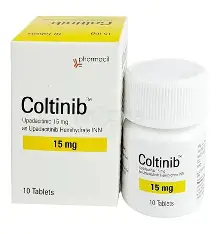
Coltinib 15-MG Tablet
Made in:
Brand:
Capacity:

Authentic Product

Easy Return

Secure payments and fast deliveries
Indications Coltinib is a Janus kinase (JAK) inhibitor indicated for the treatment of- Adults with moderate to severe active rheumatoid arthritis who have had an inadequate […]
Indications
- Adults with moderate to severe active rheumatoid arthritis who have had an inadequate response or intolerance to one or more TNF blockers.
- Adults and pediatric patients 2 years of age and older with active psoriatic arthritis who have had an inadequate response or intolerance to one or more TNF blockers.
- Adults and pediatric patients 12 years of age and older with refractory, moderate to severe atopic dermatitis whose disease is not adequately controlled with other systemic drug products, including biologics, or when use of those therapies are inadvisable.
- Adults with moderately to severely active ulcerative colitis who have had an inadequate response or intolerance to one or more TNF blockers.
- Adults with moderately to severely active Crohn’s disease who have had an inadequate response or intolerance to one or more TNF blockers.
- Adults with active ankylosing spondylitis who have had an inadequate response or intolerance to one or more TNF blockers.
- Adults with active nonradiographic axial spondyloarthritis with objective signs of inflammation who have had an inadequate response or intolerance to TNF blocker therapy.
- Patients 2 years of age and older with active polyarticular juvenile idiopathic arthritis who have had an inadequate response or intolerance to one or more TNF blockers.
Dosage & Administration
Psoriatic Arthritis:
- Adults 18 Years of Age and Older: 15 mg once daily.
Atopic Dermatitis:
- 12 kg-65 kg (Weighing at least 40 kg): Initiate with 15 mg once daily. If an adequate response is not achieved, consider increasing the dosage to 30 mg once daily. Discontinue if an adequate response is not achieved with the 30 mg dose.
- Adults 65 Years of Age and Older: 15 mg once daily.
Ulcerative Colitis (Adult Patients):
- Induction: 45 mg once daily for 8 weeks.
- Maintenance: 15 mg once daily. A dosage of 30 mg once daily may be considered for patients with refractory, severe or extensive disease. Discontinue if an adequate therapeutic response is not achieved with the 30 mg dosage.
Crohn’s Disease (Adult Patients)
- Induction: 45 mg once daily for 12 weeks.
- Maintenance: 15 mg once daily. A dosage of 30 mg once daily may be considered for patients with refractory, severe or extensive disease. Discontinue if an adequate therapeutic response is not achieved with the 30 mg dosage.
Ankylosing Spondylitis: 15 mg once daily.
Non-radiographic Axial Spondyloarthritis: 15 mg once daily.
Polyarticular Juvenile Idiopathic Arthritis: (30 kg and greater): 15 mg once daily.
Interaction
Strong CYP3A4 Inducers: Coltinib exposure is decreased when co-administered with strong CYP3A4 inducers (such as rifampin), which may lead to reduced therapeutic effect of Coltinib. Coadministration of Coltinib with strong CYP3A4 inducers is not recommended.
Side Effects
Atopic Dermatitis: Adverse reactions (≥1%) are: upper respiratory tract infections, acne, herpes simplex, headache, blood creatine phosphokinase increased, cough, hypersensitivity, folliculitis, nausea, abdominal pain, pyrexia, increased weight, herpes zoster, influenza, fatigue, neutropenia, myalgia, and influenza like illness.
Ulcerative Colitis: Adverse reactions (≥5%) reported during induction or maintenance are: upper respiratory tract infections, increased blood creatine phosphokinase, acne, neutropenia, elevated liver enzymes, and rash.
Crohn’s Disease: Adverse reactions (≥5%) reported during induction or maintenance are: upper respiratory tract infections, anemia, pyrexia, acne, herpes zoster, and headache.
Pregnancy & Lactation
Precautions & Warnings
Malignancy: Consider the risks and benefits of Coltinib treatment prior to initiating therapy in patients with a known malignancy.
Thrombosis: Consider the risks and benefits prior to treating patients who may be at increased risk of thrombosis. Promptly evaluate patients with symptoms of thrombosis and treat appropriately.
Gastrointestinal Perforations: Use with caution in patients who may be at increased risk.
Laboratory Monitoring: Recommended due to potential changes in lymphocytes, neutrophils, hemoglobin, liver enzymes and lipids.
Embryo-Fetal Toxicity: Coltinib may cause fetal harm based on animal studies. Advise females of reproductive potential of the potential risk to a fetus and to use effective contraception.
Vaccinations: Avoid use of Coltinib with live vaccines.
Use in Special Populations
Hepatic Impairment: Coltinib is not recommended in patients with severe hepatic impairment.
Renal Impairment: For Coltinib, no dosage adjustment is needed for rheumatoid arthritis, psoriatic arthritis, ankylosing spondylitis, non-radiographic axial spondyloarthritis, or polyarticular juvenile idiopathic arthritis patients with mild to severe renal impairment. For atopic dermatitis, the maximum dose is 15 mg once daily with severe renal impairment. For ulcerative colitis or Crohn’s disease with severe renal impairment, the recommended dose is 30 mg once daily for induction and 15 mg once daily for maintenance. Coltinib is not recommended in end-stage renal disease for atopic dermatitis, ulcerative colitis, or Crohn’s disease.
Overdose Effects
Therapeutic Class
Storage Conditions
| Capacity | 10 pcs 1 Packet |
|---|
Related products
- Capacity: 10 Tablets (1 Strip)
৳ 250.00
- Capacity: 10 Tablets (1 Strip)
৳ 500.00
- Capacity: 10 Tablets (1 Strip)
৳ 120.40
- Capacity: 10 Tablets (1 Strip)
৳ 280.00
- Capacity: 10 Tablets (1 Strip)
৳ 200.00




Reviews
There are no reviews yet.