


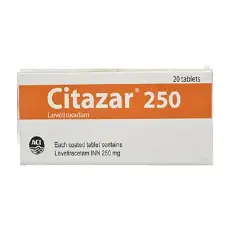
Citazar 250mg Tablet
Made in:
Brand:
Capacity:

Authentic Product

Easy Return

Secure payments and fast deliveries
Indications Citazar is indicated as monotherapy in the treatment of partial-onset seizures with or without secondary generalization in adults and adolescents from 16 years of age […]
Indications
- in the treatment of partial-onset seizures with or without secondary generalization in adults, adolescents, children and infants from 1 month of age with epilepsy.
- in the treatment of myoclonic seizures in adults and adolescents from 12 years of age with Juvenile Myoclonic Epilepsy.
- in the treatment of primary generalized tonic-clonic seizures in adults and adolescents from 12 years of age with Idiopathic Generalised Epilepsy.
Adults (≥18 years) and adolescents (12 to 17 years) weighing 50 kg or more: The initial therapeutic dose is 500 mg twice daily. This dose can be started on the first day of treatment. Depending upon the clinical response and tolerability, the daily dose can be increased up to 1,500 mg twice daily. Dose changes can be made in 500 mg twice daily increases or decrease every two to four weeks.
Pediatric population: The tablet formulation is not adapted for use in infants and children under the age of 6 years. Oral solution is the preferred formulation for use in this population. In addition, the available dose strengths of the tablets are not appropriate for initial treatment in children weighing less than 25 kg, for patients unable to swallow tablets or for the administration of doses below 250 mg. In all of the above cases, oral solution should be used.
- Monotherapy: The safety and efficacy of levetiracetam in children and adolescents below 16 years as monotherapy treatment have not been established.
- Add-on therapy: Oral solution is the preferred formulation for use in infants and children under the age of 6 years. For children 6 years and above, oral solution should be used for doses under 250 mg, for doses not in multiples of 250 mg when dosing recommendation is not achievable by taking multiple tablets and for patients unable to swallow tablets. The lowest effective dose should be used. The starting dose for a child or adolescent of 25 kg should be 250 mg twice daily with a maximum dose of 750 mg twice daily. Dosing for children 50 kg or greater is the same as in adults.
- Add-on therapy: For infants aged from 1 month to less than 6 months: The oral solution is the formulation to use in infants.
Administration
Interaction
Probenecid: Probenecid (500 mg four times daily), a renal tubular secretion blocking agent, has been shown to inhibit the renal clearance of the primary metabolite but not of Citazar. Nevertheless, the concentration of this metabolite remains low.
Methotrexate: Concomitant administration of Citazar and methotrexate has been reported to decrease methotrexate clearance, resulting in increased/prolonged blood methotrexate concentration to potentially toxic levels. Blood methotrexate and Citazar levels should be carefully monitored in patients treated concomitantly with the two drugs.
Laxatives: There have been isolated reports of decreased Citazar efficacy when the osmotic laxative macrogol has been concomitantly administered with oral Citazar. Therefore, macrogol should not be taken orally for one hour before and for one hour after taking Citazar.
Food and alcohol: The extent of absorption of Citazar was not altered by food, but the rate of absorption was slightly reduced. No data on the interaction of Citazar with alcohol are available.
- Adult patients: somnolence, asthenia, infection and dizziness
- Pediatric patients: fatigue, aggression, nasal congestion, decreased appetite, and irritability
Pregnancy & Lactation
Precautions & Warnings
Acute kidney injury: The use of Citazar has been very rarely associated with acute kidney injury with a time to onset ranging from a few days to several months.
Blood cell counts: Rare cases of decreased blood cell counts (neutropenia, agranulocytosis, leucopenia, thrombocytopenia and pancytopenia) have been described in association with Citazar administration, generally at the beginning of the treatment. Complete blood cell counts are advised in patients experiencing important weakness, pyrexia, recurrent infections or coagulation disorders.
Suicide: Suicide, suicide attempt, suicidal ideation and behaviour have been reported in patients treated with anti-epileptic agents (including Citazar). A meta-analysis of randomized placebo-controlled trials of anti-epileptic medicinal products has shown a small increased risk of suicidal thoughts and behaviour. The mechanism of this risk is not known. Therefore patients should be monitored for signs of depression and/or suicidal ideation and behaviours and appropriate treatment should be considered. Patients (and caregivers of patients) should be advised to seek medical advice should signs of depression and/or suicidal ideation or behaviour emerge.
Paediatric population: The tablet formulation is not adapted for use in infants and children under the age of 6 years. Available data in children did not suggest an impact on growth and puberty. However, long term effects on learning, intelligence, growth, endocrine function, puberty and childbearing potential in children remain unknown.
Use in Special Populations
Renal impairment: The daily dose must be individualized according to renal function.
Hepatic impairment: No dose adjustment is needed in patients with mild to moderate hepatic impairment. In patients with severe hepatic impairment, the creatinine clearance may underestimate renal insufficiency. Therefore a 50 % reduction of the daily maintenance dose is recommended when the creatinine clearance is < 60 ml/min.
Overdose Effects
| Capacity | 10 Tablets (1 Strip) |
|---|
Related products
- Capacity: 10 Tablets (1 Strip)
৳ 200.00
- Capacity: 10 tablet ( 1strip )
৳ 30.10
- Capacity: 10 Tablets (1 Strip)
৳ 30.10
- Capacity: 10 Tablets (1 Strip)
৳ 100.30
- Capacity: 10 tablet ( 1strip )
৳ 120.40



Reviews
There are no reviews yet.