


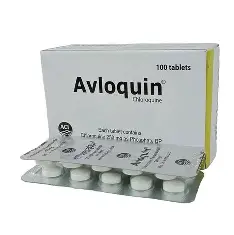
Avloquin 250mg Tablet
Made in:
Brand:
Capacity:

Authentic Product

Easy Return

Secure payments and fast deliveries
Indications Avloquin is indicated in the following cases: Treatment of malaria Prophylaxis and suppression of malaria Treatment of amoebic hepatitis and abscess Treatment of discoid and […]
Indications
- Treatment of malaria
- Prophylaxis and suppression of malaria
- Treatment of amoebic hepatitis and abscess
- Treatment of discoid and systemic and systemic lupus erythematosus
- Treatment of rheumatoid arthritis
Syrup: Each 5 mL contains Chloroquine Phosphate BP 80 mg equiv. to approx. 50 mg of Chloroquine base.
Dosage & Administration
For the treatment of acute attack of malaria:
- Adults and children: 25 mg of chloroquine base per kg body-weight given over 3 days. This total dose is given in a variety of ways. One way is to give 10 mg per kg followed after 6 to 8 hours by 5 mg per kg, then 5 mg per kg daily for the next 2 days; alternatively, 10 mg per kg may be given daily for the first 2 days and 5 mg per kg on the 3rd day. Sometimes the adult doses are not expressed in terms of body weight but as 600 mg followed after 6 to 8 hours by 300 mg, then 300 mg daily for the next 2 days.
For clinical prophylaxis:
- Adult: An oral dose equivalent to 300 mg chloroquine base is given every 7 days for about one week before, during, and for at least 4 weeks after exposure.
- Children: A weekly oral dose of 5 mg per kg body-weight has been recommended.
For hepatic amoebiasis: Adult:
- 600 mg base daily for two days, followed by 300 mg base daily for at least 2-3 weeks. Treatment is usually combined with an effective intestinal amoebicide.
- For discoid and systemic lupus erythematosus: Suggested oral dose is 150 mg of base daily, reducing gradually once symptoms have been controlled.
For rheumatoid arthritis:
- Adult: 150 mg of base daily, some clinicians suggest that treatment should be given for only 10 months in each year.
- Children: 3 mg/kg body-weight base daily.
For the management of photoallergic reactions:
- Adult: 150 to 300 mg of base daily during periods of intense light exposure.
- Children: 3 mg/kg body-weight
For porphyria cutanea tarda:
- Adult: When chloroquine was first used at this condition at doses of 150 mg to 600 mg of base per day for 4-7 days, a severe life threatening toxic hepatitis developed. Use of low dose therapy with 75 mg of base 2 to 3 times per week for 6 to 18 months can avoid such effects and lead to remission.
Interaction
Contraindications
- Known or suspected chloroquine resistance in P. falciparum.
- Hypersensitivity.
- Retinal damage.
- Concurrent therapy with hepatotoxic drugs.
Side Effects
personality changes.
Visual disturbances: Blurred vision and difficulties in focusing, keratopathy, retinopathy.
Haematological: Aplastic anaemia, agranulocytosis, thrombocytopenia and neutropenia.
Others: Loss of hair, bleaching of hair pigment, bluish black pigmentation of the mucous membranes and skin, photosensitivity, tinnitus, reduced hearing, nerve deafness, uromyopathy and myopathy.
Pregnancy & Lactation
malaria when in the judgement of the physician the benefit outweighs the possible hazard. Because of the potential for serious adverse reactions in nursing infants from chloroquine, a decision should be made whether to discontinue nursing or to discontinue the drug taking into account the importance of the drug to the mother.
Precautions & Warnings
- The eyes should be examined before starting long-term treatment and should be monitored subsequently.
- Visual disturbances may render patients unfit to take charge of vehicles or machinery.
- Care is necessary in administering to patients with impaired liver or renal function or to those with prophyria, psoriasis, or a history of epilepsy.
- Patients with glucose-6-phosphate dehydrogenase (G6PD) deficiency should be observed for haemolytic anaemia during chloroquine treatment.
Therapeutic Class
Storage Conditions
| Capacity | 10 Tablets (1 Strip) |
|---|
Related products
- Capacity: 10 Tablets (1 Strip)
৳ 450.00
- Capacity: 10 Tablets (1 Strip)
৳ 250.00
- Capacity: 10 Tablets (1 Strip)
৳ 30.10
- Capacity: 10 tablet ( 1strip )
৳ 120.40
- Capacity: 10 Tablets (1 Strip)
৳ 40.10


Reviews
There are no reviews yet.