


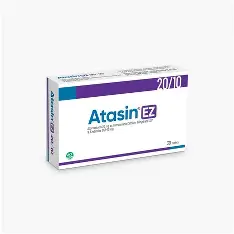
Atasin EZ 20/10MG Tablet
Made in:
Brand:
Capacity:

Authentic Product

Easy Return

Secure payments and fast deliveries
Indications Therapy with lipid-altering agents should be only one component of multiple risk factor intervention in individuals at significantly increased risk for atherosclerotic vascular disease due […]
Indications
Primary Hyperlipidemia: Atasin EZ tablet is indicated for the reduction of elevated total cholesterol (total-C), low density lipoprotein cholesterol (LDL-C), apolipoprotein B (Apo B), triglycerides (TG), and non-high-density lipoprotein cholesterol (non-HDL-C), and to increase high-density lipoprotein cholesterol (HDL-C) in patients with primary (heterozygous familial and non-familial) hyperlipidemia or mixed hyperlipidemia.
Homozygous Familial Hypercholesterolemia (HoFH): Atasin EZ tablet is indicated for the reduction of elevated total-C and LDL-C in patients with homozygous familial hypercholesterolemia, as an adjunct to other lipid lowering treatments (e.g., LDL apheresis) or if such treatments are unavailable.
Ezetimibe: Ezetimibe reduces blood cholesterol by inhibiting the absorption of cholesterol by the small intestine. The molecular target of ezetimibe has been shown to be the sterol transporter, Niemann-Pick C1-Like 1 (NPC1L1), which is involved in the intestinal uptake of cholesterol and phytosterols. In a 2-week clinical study in 18 hypercholesterolemic patients, ezetimibe inhibited intestinal cholesterol absorption by 54%, compared with placebo. Ezetimibe had no clinically meaningful effect on the plasma concentrations of the fat-soluble vitamins A, D, and E and did not impair adrenocortical steroid hormone production. Ezetimibe does not inhibit cholesterol synthesis in the liver or increase bile acid excretion. Ezetimibe localizes at the brush border of the small intestine and inhibits the absorption of cholesterol, leading to a decrease in the delivery of intestinal cholesterol to the liver. This causes a reduction of hepatic cholesterol stores and an increase in clearance of cholesterol from the blood; this distinct mechanism is complementary to that of statins.
Patients with Homozygous Familial Hypercholesterolemia: The dosage in patients with homozygous familial hypercholesterolemia is 40/10 mg or 80/10 mg daily. This should be used as an adjunct to other lipid-lowering treatments (e.g., LDL apheresis) in these patients or if such treatments are unavailable.
Patients with Hepatic Impairment: This is contraindicated in patients with active liver disease or unexplained persistent elevations in hepatic transaminase levels.
Patients with Renal Impairment: A history of renal impairment may be a risk factor for statin-associated myopathy. These patients need closer monitoring for skeletal muscle effects. In patients with renal impairment, no dosage adjustment is necessary.
Pregnancy & Lactation
Precautions & Warnings
Liver Enzymes: It is recommended that liver enzyme tests be obtained prior to initiating therapy with Atasin EZ and repeated as clinically indicated. If serious liver injury with clinical symptoms and/or hyperbilirubinemia or jaundice occurs during treatment with Atasin EZ, promptly interrupt therapy. If an alternate etiology is not found, do not restart Atasin EZ. Active liver disease or unexplained persistent transaminase elevations are contraindications to the use of Atasin EZ.
Endocrine Function: Caution should be exercised if Atasin EZ is administered concomitantly with drugs that may decrease the levels or activity of endogenous steroid hormones, such as ketoconazole, spironolactone, and cimetidine.
Use in Special Populations
Geriatric Use: In geriatric patients, no dosage adjustment is necessary.
Overdose Effects
Therapeutic Class
Storage Conditions
| Capacity | 10 Tablets (1 Strip) |
|---|
Related products
- Capacity: 10 tablet ( 1strip )
৳ 30.10
- Capacity: 10 Tablets (1 Strip)
৳ 500.00
- Capacity: 10 Tablets (1 Strip)
৳ 100.30
৳ 20.80
- Capacity: 10 Tablets (1 Strip)
৳ 50.20


Reviews
There are no reviews yet.