


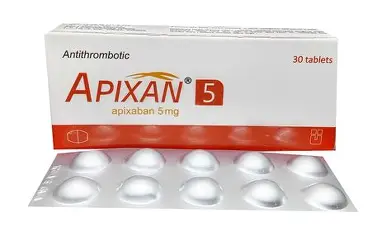
Apixan 5-MG Tablet
Made in:
Brand:
Capacity:

Authentic Product

Easy Return

Secure payments and fast deliveries
Indications Apixan is a factor Xa inhibitor indicated: To reduce the risk of stroke and systemic embolism in patients with nonvalvular atrial fibrillation For the prophylaxis […]
Indications
- To reduce the risk of stroke and systemic embolism in patients with nonvalvular atrial fibrillation
- For the prophylaxis of deep vein thrombosis (DVT), which may lead to pulmonary embolism (PE), in patients who have undergone hip or knee replacement surgery
- For the treatment of DVT and PE, and for the reduction in the risk of recurrent DVT and PE following initial therapy
Dosage & Administration
Dosage Adjustments: The recommended dose of Apixaban is 2.5 mg twice daily in patients with any 2 of the following characteristics:
- age ≥80 years,
- body weight ≤60 kg,
- serum creatinine ≥1.5mg/dl.
CYP3A4 and P-gp inhibitors: When Apixaban is coadministered with drugs that are strong dual inhibitors of cytochrome P450 3A4 (CYP3A4) and P-glycoprotein (P-gp) (e.g. ketoconazole, itraconazole, ritonavir, clarithromycin) the recommended dose is 2.5 mg twice daily.
Missed Dose: If a dose of Apixaban is not taken at the scheduled time, the dose should be taken as soon as possible on the same day and twice-daily administration should be resumed. The dose should not be doubled to make up for a missed dose.
Discontinuation for Surgery and Other Interventions: Apixaban should be discontinued at least 48 hours prior to elective surgery or invasive procedures with a moderate or high risk of unacceptable or clinically significant bleeding. Apixaban should be discontinued at least 24 hours prior to elective surgery or invasive procedures with a low risk of bleeding or where the bleeding would be non-critical in location and easily controlled.
Switching from or to Apixaban:
- Switching from warfarin to Apixaban: Warfarin should be discontinued and Apixaban started when the international normalized ratio (INR) is below 2.0.
- Switching from Apixaban to warfarin: Apixaban affects INR, so that INR measurements during co-administration with warfarin may not be useful for determining the appropriate dose of warfarin. If continuous anticoagulation is necessary, discontinue Apixaban and begin both a parenteral anticoagulant and warfarin at the time the next dose of Apixaban would have been taken, discontinuing the parenteral anticoagulant when INR reaches an acceptable range.
- Switching between Apixaban and anticoagulants other than warfarin: Discontinue one being taken and begin the other at the next scheduled dose.
Interaction
Contraindications
Side Effects
Pregnancy & Lactation
Labor and Delivery: Safety and effectiveness of Apixaban during labor and delivery have not been studied in clinical trials. Consider the risks of bleeding and of stroke in using Apixaban in this condition.
Nursing Mothers: It is unknown whether Apixaban or its metabolites are excreted in human milk. Women should be instructed either to discontinue breastfeeding or to discontinue Apixaban therapy, taking into account the importance of the drug to the mother.
Precautions & Warnings
Use in Special Populations
Renal Impairment: The dosing adjustment for moderate renal impairment is described above. No data inform use in patients with creatinine clearance <15 ml/min or on dialysis.
Pediatric Use: Safety and effectiveness in pediatric patients have not been established.
Geriatric Use: Of the total subjects in clinical studies of Apixan, >69% were 65 and older, and >31% were 75 and older. The effects of Apixan on the risk of stroke and major bleeding compared to warfarin were maintained in geriatric subjects.
Overdose Effects
Therapeutic Class
Storage Conditions
| Capacity | 10 Tablets ( 1Strips ) |
|---|
Related products
৳ 20.80
- Capacity: 10 Tablets (1 Strip)
৳ 200.00
- Capacity: 10 Tablets (1 Strip)
৳ 30.10
- Capacity: 10 Tablets (1 Strip)
৳ 500.00
- Capacity: 10 tablet ( 1strip )
৳ 120.40



Reviews
There are no reviews yet.