


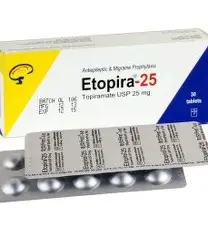
Etopira 25-MG Tablet
Made in:
Brand:
Capacity:

Authentic Product

Easy Return

Secure payments and fast deliveries
Indications Epilepsy: Etopira is indicated as monotherapy in adults and children aged 6 years and above with newly diagnosed epilepsy who have generalised tonic-clonic seizures or […]
Indications
Migraine: Etopira is indicated in adults for the prophylaxis of migraine headache. Prophylactic treatment of migraine may be considered in situations such as: adults experiencing three or more migraine attacks per month; frequent migraine attacks that significantly interfere with the patient’s daily routine. Continuing therapy should be reviewed every six months.
The exact mechanisms by which topiramate exerts pharmacological actions on seizures and migraines are currently not fully characterized. Several properties of this drug, however, are likely to contribute to its therapeutic effects. Topiramate has been observed to exert actions on voltage-dependent sodium channels, GABA receptors, and glutamate receptors.
Topiramate stimulates GABA-A receptor activity at brain non-benzodiazepine receptor sites and reduces glutamate activity at both AMPA and kainate receptors. Normally, GABA-A receptors are inhibitory and glutaminergic receptors are stimulatory for neuronal activity. By increasing GABA activity and inhibiting glutamate activity, topiramate blocks neuronal excitability, preventing seizures and migraines. Additionally, it blocks the voltage-dependent sodium channels, further blocking seizure activity. Topiramate has been shown to inhibit various carbonic anhydrase isozymes, but the clinical significance of this is unknown at this time.
Dosage & Administration
- Adults and children over 16 years: Titration should begin at 25 mg nightly for 1 week. The dosage should then be increased at 1- or 2-week intervals by increments of 25 or 59 mg/day, administered in two divided doses. The recommended initial target dose for topiramate monotherapy in adults with newly diagnosed epilepsy is 100 mg/day and the maximum recommended daily dose is 400 mg.
- Children aged 6-16 years: Treatment of children aged 6 years and above should begin at 0.5 to 1 mg/kg nightly for the first week. The dosage should then be increased at 1- or 2-week intervals by increments of 0.5 to 1 mg/kg/day, administered in two divided doses. The recommended initial target dose range for topiramate monotherapy in children with newly diagnosed epilepsy aged 6 years and above is 3 to 6 mg/kg/day. Higher doses have been tolerated and rarely doses up to 16 mg/kg/day have been given.
Epilepsy: Adjunctive therapy:
- Adults and children over 16 years: The minimal effective dose as adjunctive therapy is 200 mg per day. The usual total daily dose is 200 mg to 400 mg in two divided doses. Some patients may require doses up to 800 mg per day, which is the maximum recommended dose.
- Children aged 2-16 years: The recommended total daily dose of Topiramate as adjunctive therapy is approximately 5 to 9 mg/kg/day in two divided doses. Titration should begin at 25 mg nightly for the first week. The dosage should then be increased at 1- or 2-week intervals by increments of 1 to 3 mg/kg/day (administered in two divided doses), to achieve optimal clinical response. Dose titration should be guided by clinical outcome. Daily doses up to 30 mg/kg/day have been studied and were generally well tolerated.
Migraine:
- Adults and children over 16 years: Titration should begin at 25 mg nightly for 1-week. The dosage should then be increased in increments of 25 mg/day administered at 1-week intervals. The recommended total daily dose of topiramate as treatment for the prophylaxis of migraine headache is 100 mg/day administered in two divided doses. Some patients may experience a benefit at a total daily dose of 50 mg/day.
- Children: Topiramate in migraine prophylaxis has not been studied in children under 16 years.
Interaction
CNS Depressants: Etopira should be used with caution if used in combination with alcohol and other CNS depressants.
Oral Contraceptives: In an interaction study with a combined oral contraceptive, Etopira increased plasma clearance of the oestrogenic component significantly. Consequently, and bearing in mind the potential risk of teratogenicity, patients should receive a preparation containing not less than 50 μg of oestrogen or use some alternative non-hormonal method of contraception. Patients taking oral contraceptives should be asked to report any change in their bleeding patterns.
Lithium: In patients with bipolar disorder, the pharmacokinetics of lithium were unaffected during treatment with Etopira at doses of 200 mg/day; however, there was an observed increase in systemic exposure (26% for AUC) following Etopira doses of up to 600 mg/day. Lithium levels should be monitored when co-administered with Etopira.
Hydrochlorothiazide (HCTZ): The steady-state pharmacokinetics of HCTZ were not significantly influenced by the concomitant administration of Etopira. Clinical laboratory results indicated decreases in serum potassium after Etopira or HCTZ administration, which were greater when HCTZ and Etopira were administered in combination.
Metformin: Etopira did not affect metformin tmax. The clinical significance of the effect of Etopira on metformin pharmacokinetics is unclear. Oral plasma clearance of Etopira appears to be reduced when administered with metformin. The clinical significance of the effect of metformin on Etopira pharmacokinetics is unclear. When Etopira is added or withdrawn in patients on metformin therapy, careful attention should be given to the routine monitoring for adequate control of their diabetic disease state.
Pioglitazone: When Etopira is added to pioglitazone therapy or pioglitazone is added to Etopira therapy, careful attention should be given to the routine monitoring of patients for adequate control of their diabetic disease state.
Glibenclamide: The steady-state pharmacokinetics of Etopira were unaffected by concomitant administration of glibenclamide. When Etopira is added to glibenclamide therapy or glibenclamide is added to Etopira therapy, careful attention should be given to the routine monitoring of patients for adequate control of their diabetic disease state.
Others: Etopira, when used concomitantly with other agents predisposing to nephrolithiasis, may increase the risk of nephrolithiasis. While using Etopira, agents like these should be avoided since they may create a physiological environment that increases the risk of renal stone formation. The interaction with benzodiazepines has not been studied.
Valproic Acid: Concomitant administration of Etopira and valproic acid has been associated with hyperammonemia with or without encephalopathy in patients who have tolerated either drug alone. An association of hyperammonemia with Etopira monotherapy or concomitant treatment with other anti epileptics has not been established.
Contraindications
Side Effects
Pregnancy & Lactation
Precautions & Warnings
Overdose Effects
Therapeutic Class
Storage Conditions
| Capacity | 10 Tablets ( 1Strips ) |
|---|
Related products
- Capacity: 10 Tablets (1 Strip)
৳ 350.00
- Capacity: 10 Tablets (1 Strip)
৳ 250.00
- Capacity: 10 Tablets (1 Strip)
৳ 220.00
- Capacity: 10 tablet ( 1strip )
৳ 30.10
- Capacity: 10 Tablets (1 Strip)
৳ 40.10


Reviews
There are no reviews yet.