


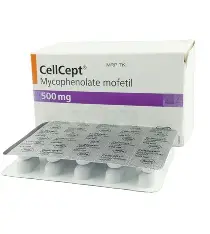
Cellcept 500-MG Tablet
Made in:
Brand:
Capacity:

Authentic Product

Easy Return

Secure payments and fast deliveries
Indications Cellcept in combination with corticosteroids and either ciclosporin or tacrolimus is indicated for- Prophylaxis of acute organ rejection and treatment of first or refractory organ […]
Indications
- Prophylaxis of acute organ rejection and treatment of first or refractory organ rejection in patients receiving allogeneic renal transplants.
- Prophylaxis of acute organ rejection in patients receiving allogeneic cardiac transplants.
- Prophylaxis of acute organ rejection in patients receiving allogeneic hepatic transplants.
- Cellcept is indicated for induction and maintenance therapy of patients with Class III-V lupus nephritis (diagnosed according to International Society of Nephrology/Renal Pathology Society classification.
Pharmacology
Pharmacodynamics: Mycophenolic acid, the active metabolite of mycophenolate mofetil, is a non-competitive, reversible inhibitor of inosine monophosphate dehydrogenase (IMPDH). Inhibition of IMPDH blocks the de novo synthesis of guanosine nucleotides which are necessary substrates for DNA and RNA synthesis. Unlike other cell types which can use the salvage pathway, B and T lymphocytes are dependent upon the de novo pathway for the generation of guanosine. Data from in vitro studies indicate that mycophenolic acid and/or mycophenolate mofetil inhibit mixed lymphocyte responses and human peripheral blood lymphocyte proliferation induced by a variety of mitogens and antigens. Mycophenolic acid decreases intracellular pools of guanosine triphosphate (GTP) and deoxyguanosine triphosphate (dGTP) in mitogen-stimulated human peripheral blood monocytes or T lymphocytic cell lines but has no effect on GTP concentrations in human neutrophils.
Dosage & Administration
Standard dosage for prophylaxis of renal rejection
- Adults: A dose of 1 g administered orally twice a day (daily dose of 2 g) is recommended for use in renal transplant patients.
- Children (aged 3 months to 18 years): Patients with a body surface area of 1.25 to 1.5 m2 may be prescribed Mycophenolate Mofetil Tablets at a dose of 750 mg twice daily (1.5 g daily dose). Patients with a body surface area >1.5 m2 may be prescribed Mycophenolate Mofetil tablets at a dose of 1 gm twice daily (2 g daily dose).
Standard dosage for prophylaxis of cardiac rejection-
- Adults: A dose of 1.5 g administered orally (over not less than 2 hour) twice a day (daily dose of 3 g) is recommended for use in cardiac transplant patients.
- Children: no data are available for pediatric cardiac transplant patients.
Standard dosage for prophylaxis of hepatic rejection-
- Adults: A dose of 1.5 g orally twice a day (daily dose of 3 g) is recommended for use in hepatic transplant patients
- Children: no data are available for pediatric hepatic transplant patients.
Standard dosage for treatment of first or refractory renal rejection-
- Adults: A dose of 1.5 g administered orally twice a day (daily dose of 3 g) is recommended for management of first or refractory rejection.
- Children: no data are available for the treatment of first or refractory renal rejection in pediatric renal transplant patients.
Lupus nephritis patients:
Standard Dosage for Induction Therapy-
- Adults: A dose of 750 mg-1.5 g administered orally twice a day (daily dose of up to 3 g) is recommended
- Children: A dose of 600 mg/m2 administered orally twice a day (up to a maximum of 2 g daily) is recommended
Standard Dosage for Maintenance Therapy-
- Adults: A dose of 500 mg-1 g administered orally twice a day is recommended
- Children: A dose of 300 mg/m2 administered orally twice a day is recommended
Mycophenolate Mofetil should be used in combination with corticosteroids. Doses should be introduced gradually and adjusted according to clinical response. Therapeutic drug monitoring could help prevent sub-therapeutic exposure (Cmin≥3.0 mg/L or inter-dose AUC ≥35 h*mg/L).
Interaction
Contraindications
Side Effects
Pregnancy & Lactation
Precautions & Warnings
- Can increase new or reactive viral infections. Such infections include latent viral reactivation, such as hepatitis B or hepatitis C reactivation, or infections caused by polyomaviruses.
- Can cause blood dyscrasias including pure red cell aplasia (PRCA).
- Can cause serious GI tract complications (gastrointestinal bleeding, perforations and ulcers).
- May increase the risk of developing lymphomas and other malignancies, particularly of the skin.
- Use of live vaccines should be avoided during treatment with Mycophenolic acid.
- Patients should not donate blood during therapy.
Use in Special Populations
Overdose Effects
Therapeutic Class
Storage Conditions
| Capacity | 10 Tablets ( 1Strips ) |
|---|
Related products
- Capacity: 10 Tablets (1 Strip)
৳ 500.00
- Capacity: 10 Tablets (1 Strip)
৳ 150.00
- Capacity: 10 Tablets (1 Strip)
৳ 40.10
- Capacity: 10 Tablets (1 Strip)
৳ 125.00
৳ 60.41


Reviews
There are no reviews yet.