


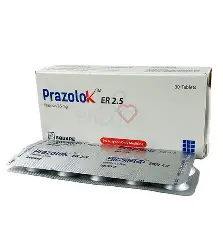
Prazolok ER 2.5MG Tablets
Made in:
Brand:
Capacity:

Authentic Product

Easy Return

Secure payments and fast deliveries
Indications Hypertension: Prazolok ER is indicated in the treatment of all grades of essential (primary) hypertension and of all grades of secondary hypertension of variec etiology. It […]
Indications
Left Ventricular Failure: Prazolok ER is indicated in the treatment of left ventricular failure. Prazolok ER may be added to the therapeutic regimen in those patients who have not shown a satisfactory response or who have become refractory to conventional therapy with diuretics, with or without cardiac glycosides.
Raynaud’s Phenomenon And Raynaud’s Disease: Prazolok ER indicated in the treatment of Raynaud’s phenomenon and Raynaud’s disease.
Benign Prostatic Hyperplasia: Prazolok ER is indicated as an adjunct in the symptomatic treatment of urinary obstruction caused by benign prostatic hyperplasia. It is also of value in patients awaiting prostatic surgery.
The therapeutic efficacy of Prazosin in patients with congestive heart failure is ascribed to a reduction in left ventricular filling pressure, reduction in cardiac impedance and an augmentation of cardiac output. The use of Prazosin in congestive heart failure does not provoke a reflex tachycardia and blood pressure reduction is minimal in normotensive patients. Prazosin reduce the severity of the signs, symptoms, frequency and duration of attacks, in patients with Raynaud’s disease. In low dosage, antagonism of alpha-1-receptors on prostatic and urethral smooth muscle has been shown to improve the urinary pressure profile in men and to improve symptoms of benign prostatic hyperplasia. Clinical studies have shown that Prazosin therapy is not associated with adverse changes in the serum lipid profile.
Dosage & Administration
Hypertension: For maximum benefit, small increases should be continued until the desired effect is achieved or a total daily dosage of 20 mg is reached. A diuretic or adrenergic beta-blocking agent may be added to enhance efficacy. The maintenance dosage of Prazosin may be given as a twice or three times daily regimen.
- Patients Receiving No Antihypertensive Therapy. It is recommended that therapy be initiated with 0.5 mg given in the evening at bedtime then 0.5 mg b.i.d. or t.i.d for three to seven days. Unless poor toleration suggests the patient is unusually sensitive, this dosage should be increased to 1 mg given b.i.d. or t.i.d. for a further three to seven days. Thereafter, as determined by the patient’s response to the blood pressure lowering effect, the dosage should be increased gradually to a total daily dosage of 20 mg given in divided doses.
- Patients Receiving Diuretic Therapy With inadequate Control of Blood Pressure. The diuretic should be reduced to a maintenance dosage level for the particular agent and Prazosin initiated with 0.5 mg h.s then proceeding to 0.5 mg b.i.d or t.i.d. After the initial period of observation, the dosage of Prazosin should be gradually increased as determined by the patient’s response.
- Patients Receiving Other Antihypertensives But With Inadequate Control. Because some additive effect is anticipated, the other agent dosage level (e.g. beta-adrenergic blocking agents, methyldopa. reserpine, lsnidine etc.) should be reduced and Prazosin initiated at 0.5 mg h.s. then proceeding to 0.5 mg b.i.d, or t.i.d. Subsequent dosage increase should be made depending upon the patient’s response. There is evidence that adding Prazosin to beta-adrenergic blocking agents, calcium antagonists or ACE inhibitors may bring about a substantial reduction in blood pressure. Thus, to low initial dosage regimen is strong, recommended.
- Patients With Moderate to Severe Grades of Renal Impairment Evidence to date shows that Prazosin does not further compromise renal function when used in patients with renal impairment. Because some patients in this category have responded to small doses of Prazosin , it is recommended that therapy be initiated at 0.5 mg daily and that dosage increases be instituted cautiously.
Left Ventricular Failure: The recommended starting dose is 0.5 mg two, three or four times a day, Dosage should be titrated according to the patent’s clinical response, based on careful monitoring of cardiopulmonary signs and symptoms, and when indicated, hemodynamic studies. Dosage titration steps may be performed as often as every two or three days in patients under close medical supervision. In severely ill, decompensated patients, rapid dosage titiration over one to two days may be indicated and is best done when hemodynamic- monitoring is available In dininai studies, the therapeutic dosages ranged from 4 mg to 20 mg daily in divided doses. Adjustment of dosage may be required in the course of Prazosin therapy in some patients to maintain optimal clinical improvement.
- Suggested Starting Dosage: 0.5 mg b.i.d., t.i.d. or q.i.d. increasing to 4 mg in divided doses.
- Use Daily Maintenance Dosage: 4 mg once daily to 20 mg in divided doses.
Raynaud’s Phenomenon And Raynaud’s Disease: The recommended starting dosage is 0.5 mg b.i.d. given for a period of three to seven days. Dosage should be adjusted according to the patient’s clinical response.
Suggested Starting Dosage: 0.5mg b.i.d.
Usual Daily Maintenance Dosage: 1mg or 2 mg b.i.d Doses up to 2 mg t.i.d. may be required for some patients.
Benign Prostatic Hyperplasia: The recommended starting dose is 0.5 mg twice daily given for a period of 3 to 7 days and should then be adjusted according to the patient’s clinical responses. The usual maintenance dose is 2 mg twice daily. The safety and efficacy of a total daily dosage greater than 4 mg have not been established. Therefore, total daily dosages greater than 4mg should be used with caution.
Prazosin XR Tablet: Prazosin XR Extended-Release Tablets must be swallowed whole and should not be bitten or divided. Therapy for hypertension with Prazosin XR must be initiated at 2.5 mg once daily. The 5 mg dosage form of Prazosin XR is not for initial dosing. Dosage may be increased slowly, in general over a 7 to 14-day period, depending on the response to each dose level. Doses above 20 mg once daily have not been studied.
Maintenance Dose: Dosage may be increased as clinically indicated to 20 mg given in once-daily doses.
- Hypertensive patients controlled on Prazosin Tablets alone or in combination with other antihypertensive medications may be switched to Prazosin XR Extended Release Tablets at the equivalent or nearest higher total daily dose, e.g. Prazosin Tablets 4 mg daily equivalent to Prazosin XR Extended Release Tablets 5 mg once daily. Blood pressure measurements should be taken at the end of the dosing interval to assure adequate blood pressure control is maintained throughout the 24-hour period. Further titration may be necessary in some patients.
- The addition of a diuretic or other antihypertensive agent to prazosin has been shown to cause an additive hypotensive effect.
Interaction
- Cardiac-glycosides-digitalis and digoxin;
- Hypoglycemic agents-insulin, chlorpropamide, phenformin, tolazamide, and tolbutamide;
- tranquilizers and sedatives-chlordiazepoxide, diazepam and phenobarbital;
- antiarrhythmic agents-procainamide, propranolol and quinidine; and
- analgesic, antipyretic and anti-inflammatory agents-propxyphene, aspirin, indomethacin and phenylbutazone type.
Contraindications
Side Effects
Pregnancy & Lactation
Precautions & Warnings
Left Ventricular Failure: When prazosin is initially administered to patients with left ventricular failure who have undergone vigorous diuretic or other vasodilator treatment, particularly in higher than the recommended starting dose, the resultant decrease in left ventricular filling pressure may be associated with a significant fall in cardiac output and systemic blood pressure. In such patients, observance of the recommended starting dose of prazosin followed by gradual titration is particularly important. (See dosage and administration). In occasional patients with left ventricular failure, the clinical efficacy of Prazolok ER has been reported to diminish after several months of treatment. In these patients, there is usually evidence of weight gain or peripheral edema indicating fluid retention. Since spontaneous deterioration may occur in such severely ill patients a causal relationship to prazosin therapy has not been established. Thus, as with all patients with left ventricular failure, careful adjustment of diuretic dosage according to the patient’s clinical condition is required to prevent excessive fluid retention and consequent relief of symptoms. In those patients without evidence of fluid retention, when clinical improvement has diminished; an increase in the dosage, of Prazolok ER will usually restore clinical efficacy.
Raynaud’s Phenomenon and Raynaud’s Disease: Because Prazolok ER decreases peripheral vascular resistance, careful monitoring of blood pressure during initial administration and titration of Prazolok ER is suggested. Close observation is especially recommended for patients already taking medication that are known the lower blood pressure.
Benign Prostatic Hyperplasia: Prazolok ER decreases peripheral vasular resistance and since many patients with this disorder are elderly, careful monitoring of blood pressure during initial administration and during adjustment of the dose of Prazolok ER is suggested. Close observation is especially recommended for patients taking medications that are known to lower blood pressure.
Use in Special Populations
Left Ventricular Failure: Prazolok ER is not recommended in the treatment of left ventricular failure due to mechanical obstrcution such as aortic valve stenosis, mitral valve stenosis, pulmonary embolism and restrictive pericardial disease. Adequate data are not yet available to establish efficacy in patients with left ventricular failure due to a recent myocardial infarction.
Overdose Effects
Therapeutic Class
Storage Conditions
| Capacity | 10 Tablets ( 1Strips ) |
|---|
Related products
- Capacity: 10 tablet ( 1strip )
৳ 30.10
- Capacity: 10 Tablets (1 Strip)
৳ 220.00
- Capacity: 10 Tablets (1 Strip)
৳ 120.40
- Capacity: 10 Tablets (1 Strip)
৳ 350.00
- Capacity: 10 Tablets (1 Strip)
৳ 450.00




Reviews
There are no reviews yet.