


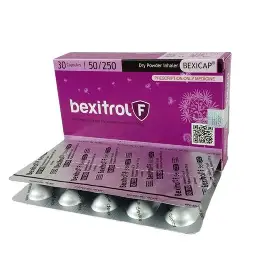
Bexitrol F 50/250MG Inhalation Capsule
Made in:
Brand:
Capacity:

Authentic Product

Easy Return

Secure payments and fast deliveries
Indications Bexitrol F is indicated in the regular treatment of asthma where use of a combination product (long-acting β2-agonist and inhaled corticosteroid) is appropriate: Patients not […]
Indications
- Patients not adequately controlled with inhaled corticosteroids and ‘as needed’ inhaled short acting β2-agonist or
- Patients already adequately controlled on both inhaled corticosteroid and long-acting β2-agonist.
Salmeterol: Salmeterol is a selective long-acting (12-hour) beta-2-adrenoceptor agonist with a long side chain that binds to the exo-site of the receptor.
Fluticasone Propionate: Fluticasone Propionate given by inhalation at recommended doses has a potent glucocorticoid anti-inflammatory action within the lungs, resulting in reduced symptoms and exacerbations of asthma, without the adverse effects observed when corticosteroids are administered systemically.
Dosage
- Adults and adolescents 12 years and older: 2 puffs of 25 µg Salmeterol and 50 µg Fluticasone twice daily or 2 puffs of 25 µg+125 µg twice daily or 2 puffs of 25 µg+250 µg twice daily.
- Children (4-12 years): 2 puffs of 25 µg+50 µg twice daily.
Inhalation capsule for asthma:
- Adult and Adolescent (12 Years and Older): 50 µg+100 µg or 50 µg+250 µg twice daily (morning and evening, approximately 12 hours apart).
- The recommended starting dosages for 50 µg+100 µg & 50 µg+250 µg for patients aged 12 years and older are based upon patients asthma severity. The maximum recommended dosage is 50 µg+500 µg twice daily.
- Pediatric Patients (4 to 11 Years): For patients with asthma who are not controlled on an inhaled corticosteroid, the dosage is 50 µg+100 µg twice daily (morning and evening, approximately 12 hours apart).
Inhalation capsule for COPD: 50 µg+250 µg twice daily (morning and evening, approximately 12 hours apart). Rinsing the mouth after each inhalation is advised.
Special patient groups: There is no need to adjust the dose in elderly patients or in those with renal impairment. There are no data available for use of this in patients with hepatic impairment.
Using the inhaler: This is a patient friendly, ready to use and easy to grip device. Use as per instructions for use.
Administration
Following simple steps can help to use Inhaler effectively (According to “National Asthma Guidelines for Medical Practitioners” published by Asthma Association):
- Take off the cap.
- Shake the inhaler (at least six times) vigorously before each use.
- If the inhaler is new or if it has not been used for a week or more, shake it well and release one puff into the air to make sure that it works.
- Breathe out as full as comfortably possible & hold the inhaler upright.
- Place the actuator into mouth between the teeth and close lips around the mouthpiece.
- While breathing deeply and slowly through the mouth, press down firmly add fully on the canister to release medicine.
- Remove the inhaler from mouth. Continue holding breath for at least for 10 seconds or as long as it is comfortable.
- If doctor has prescribed more than one inhalation per treatment, wait 1 minute between puffs (inhalations). Shake the inhaler well and repeat steps 4 to 7.
- After use, replace the cap on the mouthpiece. After each treatment, rinse mouth with water.
- Check your technique in front of a mirror from time to time, if you see a white mist during the inhalation, you may not have closed your lips properly around mouthpiece, or you may not be breathing in as you press the can. This indicates failure of technique. If this happens, repeat the procedure from step 4 carefully.
Instructions for Cleaning Inhaler: Clean your Inhaler at least once a week. Remove canister and rinse the plastic actuator and cap in warm water but do not put the metal canister into water. Dry the actuator and cap thoroughly and gently replace the metal canister into the actuator with a twisting motion. Put the cap on the mouthpiece.
Interaction
Contraindications
Side Effects
Salmeterol: The pharmacological side effects of beta-2-agonist treatment, such as tremor, subjective palpitations and headache, have been reported, but tend to be transient and reduce with regular therapy. Cardiac arrhythmia (including atrial fibrillation, supraventricular tachycardia and extra systoles) may occur, usually in susceptible patients. There have been reports of arthralgia and hypersensitivity reactions, including rash, oedema and angioedema. There have been reports of oropharyngeal irritation. There have been rare reports of muscle cramps.
Fluticasone propionate: Hoarseness and candidiasis (thrush) of the mouth and throat can occur in some patients. Cutaneous hypersensitivity reactions have been reported. Rare cases of facial and oropharyngeal oedema have been reported. Both hoarseness and incidence of candidiasis may be relieved by gargling with water after use of Salmeterol/ Fluticasone Propionate Inhaler.
Pregnancy & Lactation
Lactation: Administration of this inhalation capsule in breast-feeding mothers should only be considered if the expected benefit to the mother is greater than any possible risk to the fetus or child. There is insufficient experience of the use of salmeterol xinafoate and fluticasone propionate in human lactation. Salmeterol and fluticasone propionate concentrations in plasma after inhaled therapeutic doses are very low and therefore concentrations in human breast milk are likely to be correspondingly low. This is supported by studies in lactating animals, in which low concentrations were measured in milk. There are no data available for human breast milk.
Precautions & Warnings
Asthma-related adverse events: Serious asthma-related adverse events and exacerbations may occur during treatment with this inhalation capsule. Patients should be asked to continue treatment but to seek medical advice if asthma symptoms remain uncontrolled or worsen after initiation of this inhalation capsule.
Paradoxical Bronchospasm: As with other inhalation therapy paradoxical bronchospasm may occur with an immediate increase in wheezing after dosing. This should be treated immediately with a fast and short-acting inhaled bronchodilator. This inhalation capsule should be discontinued immediately, the patient assessed and alternative therapy instituted if necessary. The pharmacological side-effects of beta-2 agonist treatment, such as tremor, subjective palpitations and headache have been reported, but tend to be transient and to reduce with regular therapy.
Use in COPD patients: There was an increased reporting of pneumonia in studies of patients with COPD receiving salmeterol/fluticasone inhaler. Physicians should remain vigilant for the possible development of pneumonia in patients with COPD as the clinical features of pneumonia and exacerbation frequently overlap.
Corticosteroids: This inhalation capsule contains an inhaled corticosteroid (fluticasone propionate). Systemic effects may occur with any inhaled corticosteroid, particularly at high doses prescribed for long periods; these effects are much less likely to occur than with oral. Possible systemic effects include Cushing’s syndrome, Cushingoid features, adrenal suppression, growth retardation and (very rarely) behavioral disturbances in children and adolescents, decrease in bone mineral density, cataract and glaucoma. Therefore, it is important, that the patient is reviewed regularly and the dose of inhaled corticosteroid is titrated to the lowest dose at which effective control is maintained.
Use in Special Populations
Overdose Effects
Salmeterol: The signs and symptoms of Salmeterol overdose are seizures, angina, hypertension or hypotension, tachycardia, arrhythmias, nervousness, headache, tremor, muscle cramps, dry mouth, palpitation, nausea, dizziness, fatigue, malaise, and insomnia. Other signs of overdosage may include hypokalemia and hyperglycemia. Treatment consists of discontinuation of Salmeterol together with appropriate cardioselective beta-blocking agents, which should be used with caution in patients with a history of bronchospasm.
Fluticasone Propionate: Acute inhalation of Fluticasone Propionate doses in excess of those recommended may lead to temporary suppression of adrenal function. This does not need emergency action as adrenal function is recovered in a few days. Chronic overdose of inhaled Fluticasone Propionate may lead to adrenal suppression. Monitoring of adrenal reserve may be necessary. In cases of Fluticasone Propionate overdose Bexitrol F inhaler therapy may still be continued at a suitable dosage for symptom control.
Therapeutic Class
Storage Conditions
| Capacity | 10 Tablets ( 1Strips ) |
|---|
Related products
- Capacity: 10 Tablets (1 Strip)
৳ 200.00
- Capacity: 10 tablet ( 1strip )
৳ 120.40
৳ 20.80
- Capacity: 10 Tablets (1 Strip)
৳ 220.00
- Capacity: 10 Tablets (1 Strip)
৳ 100.30


Reviews
There are no reviews yet.