


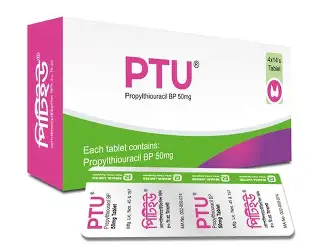
PTU 50-MG Tablet
Made in:
Brand:
Capacity:

Authentic Product

Easy Return

Secure payments and fast deliveries
Indications PTU tablet is indicated: in patients with Graves’ disease with hyperthyroidism or toxic multinodular goiter who are intolerant of methimazole and for whom surgery or […]
Indications
- in patients with Graves’ disease with hyperthyroidism or toxic multinodular goiter who are intolerant of methimazole and for whom surgery or radioactive iodine therapy is not an appropriate treatment option.
- to ameliorate symptoms of hyperthyroidism in preparation for thyroidectomy or radioactive iodine therapy in patients who are intolerant of methimazole.
Dosage & Administration
Adults: The initial dose is 300 mg daily. In patients with severe hyperthyroidism, very large goiters, or both, the initial dose may be increased to 400 mg daily; an occasional patient will require 600 to 900 mg daily initially. The usual maintenance dose is 100 to 150 mg daily.
Pediatric Patients: Propylthiouracil is generally not recommended for use in pediatric patient except in rare instances in which other alternative therapies are not appropriate options. Studies evaluating appropriate dosing regimen have not been conducted in the pediatric population although general practice would suggest initiation of therapy in patients 6 years or older at a dosage of 50 mg daily with careful upward titration based on clinical response and evaluation of TSH and free T4 levels. Although cases of severe liver injury have been reported with doses as low as 50 mg/day, most cases were associated with doses of 300 mg/day and higher.
Geriatric Patients: Reported clinical experience has not identified differences in responses between the elderly and younger patients. In general, dose selection for an elderly patient should be cautious reflecting the greater frequency of decreased hepatic, renal, or cardiac function, and of concomitant disease or other drug therapy.
Interaction
p-adrenergic blocking agents- Hyperthyroidism may cause an increased clearance of beta blockers with a high extraction ratio. A dose reduction of beta-adrenergic blockers may be needed when a hyperthyroid patient becomes euthyroid.
Digitalis glycosides- Serum digitalis levels may be increased when hyperthyroid patients on a stable digitalis glycoside regimen become euthyroid; a reduced dosage of digitalis glycosides may be needed.
Theophylline- Theophylline clearance may decrease when hyperthyroid patients on a stable theophylline regimen become euthyroid; a reduced dose of theophylline may be needed.
With food: In case of PTU, there are no specific foods that patients must exclude from diet when receiving this medication.
Contraindications
Side Effects
Rare: aplastic anaemia, drug fever, lupus-like syndrome, severe hepatic reactions, periarteritis, hypoprothrombinaemia, thrombocytopenia and bleeding, nephritis, interstitial pneumonitis, vasculitis and polymyositis.
Pregnancy & Lactation
Precautions & Warnings
PTU may cause hypothrombinaemia and bleeding so prothrombin time should be monitored during therapy, especially prior to surgery.
Some cases of severe hepatic reactions, both in adults and children, including fatal cases and cases requiring a liver transplant have been reported with PTU. In a majority of cases, the liver reaction occurred within 6 months. If significant hepatic enzyme abnormalities develop during treatment with PTU the drug should be discontinued immediately. PTU should be used with caution in patients with renal impairment or hepatic disease.
Use in Special Populations
Overdose Effects
Therapeutic Class
Storage Conditions
| Capacity | 14 Tablets ( 1 Strips ) |
|---|
Related products
- Capacity: 10 Tablets (1 Strip)
৳ 40.10
- Capacity: 10 Tablets (1 Strip)
৳ 125.00
- Capacity: 10 Tablets (1 Strip)
৳ 250.00
- Capacity: 10 Tablets (1 Strip)
৳ 100.30
- Capacity: 10 Tablets (1 Strip)
৳ 220.00



Reviews
There are no reviews yet.