


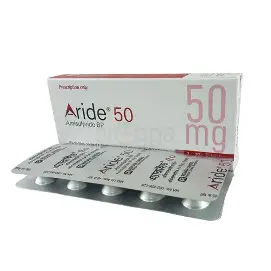
Aride 50-MG Tablet
Made in:
Brand:
Capacity:

Authentic Product

Easy Return

Secure payments and fast deliveries
Indications Aride is indicated for the treatment of acute and chronic schizophrenic disorders, in which positive symptoms (such as delusions, hallucinations, and thought disorders) and/or negative […]
Indications
Dosage & Administration
Injectable dose: The recommended injectable adult dosage of Amisulpride and infusion rate by indication is shown in the table below:
- Prevention of postoperative nausea and vomiting: 5 mg as a single intravenous injection infused over 1 to 2 minutes at the time of induction of anesthesia.
- Treatment of postoperative nausea and vomiting: 10 mg as a single intravenous injection infused over 1 to 2 minutes in the event of nausea and/or vomiting after a surgical procedure.
Interaction
- CNS depressants including narcotics, anaesthetics, analgesics, sedative H1 antihistamines, barbiturates, benzodiazepines and other anxiolytic medicines, clonidine and derivatives.
- Antihypertensive medicines and other hypotensive medications.
With food and others: Can be taken with or without food causes no interaction.
Contraindications
- Class-I anti-arrhythmic agents such as quinidine and disopyramide
- Class-II anti-arrhythmic agents such as amiodarone and sotalol
- Other medications such as bepridil, cisapride, sultopride, thioridazine, metha done, intravenous erythromycin intravenous vincamine, halofantrine, pentamidine, sparfloxacin & levodopa. In hepatic impairment amisulpride may be contraindicated to avoid the possible risk of adverse events due to an influence of the disease on amisulpride metabolism.
Side Effects
Rare: Movements that you cannot control, mainly of the face or tongue, Osteoporosis (condition, when your bones are more likely to break) or osteopenia (bone weakening), aspiration pneumonia (a type of lung infection that occurs when food, saliva, liquids, or vomit is breathed into the lungs or airways leading to the lungs, instead of being swallowed into the esophagus and stomach.
Pregnancy & Lactation
recommended during pregnancy and in women of child bearing potential not using effective contraception, unless the benefits justify the potential risks and the administered dose and duration of treatment should be as low and as short as possible. Amisulpride has been found in breast milk of treated women. Breast-feeding is contraindicated.
Precautions & Warnings
Use in Special Populations
Use in children & adolescents: Efficacy and safety of Aride in children and adolescents under 18 years of age have not been established. If absolutely required, treatment of adolescents from 15 to 18 years of age must be initiated and performed physician experienced in treating schizophrenia in this age group.
Use in hepatic impairment: Since Aride is weakly metabolized, a dosage reduction should not be necessary.
Patients with kidney problems: Treatment should be given at a lower dose. This may be half or a third of the usual daily dose, depending on how well your kidneys are working.
Use in renal impairment: Aride is eliminated by the renal route. In renal insufficiency, the dose should be reduced to half in patients with creatinine clearance (CRCL) between 30-60 mL/min and to a third in patients with CRCL between 10-30 mL/min. As there is no experience in patients with severe renal impairment (CRCL<10 mL/min) particular is recommended in these patients.
Overdose Effects
Therapeutic Class
Storage Conditions
| Capacity | 10 Tablets ( 1Strips ) |
|---|
Related products
- Capacity: 10 Tablets (1 Strip)
৳ 220.00
- Capacity: 10 Tablets (1 Strip)
৳ 120.00
- Capacity: 10 Tablets (1 Strip)
৳ 80.00
- Capacity: 10 Tablets (1 Strip)
৳ 120.40
- Capacity: 10 Tablets (1 Strip)
৳ 40.10


Reviews
There are no reviews yet.