


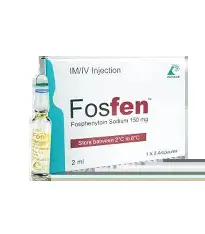
Fosfen Injection
Made in:
Brand:
Capacity:

Authentic Product

Easy Return

Secure payments and fast deliveries
Indications Fosfen is indicated for short-term parenteral administration when other means of Phenytoin administration are unavailable, inappropriate or deemed less advantageous. Fosfen can be used for […]
Indications
The safety and effectiveness of Fosfen in this use has not been systematically evaluated for more than 5 days.
Dosage & Administration
Status Epilepticus: By intravenous infusion (at a rate of 100-150 mg/minute), initially 15 mg/kg then by intramuscular injection or by intravenous infusion (at a rate of 50-100 mg/minute), 4-5 mg/kg daily in 1-2 divided doses, dose adjusted according to response and through plasma-phenytoin concentration.
Child 5 years and over: By intravenous infusion (at a rate of 2-3 mg/kg/minute), initially 15 mg/kg then by intravenous infusion (at a rate of 1-2 mg/kg/minute), 4-5 mg/kg daily in 1-4 divided doses, dose adjusted according to response and through plasma-phenytoin concentration.
Prophylaxis or treatment of seizures associated with neurosurgery or head injury: by intramuscular injection or by intravenous infusion (at a rate of 50-100 mg/minute, initially 10-15 mg/kg then by intramuscular injection or by intravenous infusion (at a rate of 50-100 mg/minute), 4-5 mg/kg daily (in 1-2 divided doses), dose adjusted according to response and through plasma-phenytoin concentration.
Child 5 years and over: By intravenous infusion (at a rate of 1-2 mg/kg/minute), initially 10-15 mg/kg then 4-5 mg/kg daily in 1-4 divided doses, dose adjusted according to response and through plasma-phenytoin concentration.
Temporary substitution for oral Phenytoin: By intramuscular injection or by intravenous infusion (at a rate of 50-100 mg/minute), same dose and dosing frequency as oral Phenytoin therapy.
Child 5 years and over: By intravenous infusion (at a rate of 1-2 mg/kg/minute), same dose and dosing frequency as oral Phenytoin therapy.
Patients with Renal or Hepatic Disease: After IV Fosphenytoin administration to patients with renal and/or hepatic disease, or in those with hypoalbuminemia, Fosphenytoin clearance to Phenytoin may be increased without a similar increase in Phenytoin clearance. This has the potential to increase the frequency and severity of adverse events.
Elderly: Age does not have a significant impact on the pharmacokinetics of Fosphenytoin following Fosphenytoin administration. Phenytoin clearance is decreased slightly in elderly patients and lower or less frequent dosing may be required.
Interaction
Drugs that may increase plasma Phenytoin concentrations include: Acute alcohol intake, Amiodarone, Chloramphenicol, Chlordiazepoxide, Cimetidine, Diazepam, Dicumarol, Disulfiram, Estrogens, Ethosuximide, Fluoxetine, H2-Antagonists, Halothane, Isoniazid, Methylphenidate, Phenothiazines, Phenylbutazone, Salicylates, Succinimides, Sulfonamides, Tolbutamide, Trazodone.
Drugs that may decrease plasma phenytoin concentrations include: Carbamazepine, chronic alcohol abuse, Reserpine.
Drugs that may either increase or decrease plasma Phenytoin concentrations include: Phenobarbital, Valproic Acid, and Sodium Valproate. Similarly, the effects of Phenytoin on Phenobarbital, Valproic Acid and Sodium plasma Valproate concentrations are unpredictable.
Contraindications
Side Effects
General Safety Advice: Intravenous infusion of Fosfen has been associated with severe cardiovascular reactions including asystole, ventricular fibrillation, and cardiac arrest. Hypotension, bradycardia, and heart block have also been reported. The safety advices:
- Monitor heart rate, blood pressure, and respiratory function for duration of infusion .
- Observe patient for at least 30 minutes after infusion.
- If hypotension occurs, reduce infusion rate or discontinue.
- Reduce dose or infusion rate in elderly, and in renal or hepatic impairment.
Pregnancy & Lactation
Precautions & Warnings
Status Epilepticus Dosing Regime: Do not administer Fosfen at a rate greater than 150 mg PE/min. The dose of IV Fosfen (15 to 20 mg PE/kg) that is used to treat status epilepticus is administered at a maximum rate of 150 mg PE/min. The typical Fosfen infusion administered to a 50 kg patient would take between 5 and 7 minutes. If rapid Phenytoin loading is a primary goal, IV administration of Fosfen is preferred.
Withdrawal Precipitated Seizure, Status Epilepticus: Antiepileptic drugs should not be abruptly discontinued because of the possibility of increased seizure frequency, including status epilepticus. When the need for dosage reduction, discontinuation, or substitution of alternative antiepileptic medication arises, this should be done gradually. However, in the event of an allergic or hypersensitivity reaction, rapid substitution of alternative therapy may be necessary.
Cardiovascular Depression: Fosfen should be used with caution in patients with hypotension and severe myocardial insufficiency.
Rash: Fosfen should be discontinued if a skin rash appears.
Hepatic Injury: Cases of acute hepatotoxicity, including infrequent cases of acute hepatic failure, have been reported with Phenytoin. In these patients with acute hepatotoxicity, Fosfen should be immediately discontinued and not readministered.
Hemopoietic System: Hemopoietic complications, some fatal, have occasionally been reported in association with administration of Phenytoin. These have included thrombocytopenia, leukopenia, granulocytopenia, agranulocytosis, and pancytopenia with or without bone marrow suppression.
Alcohol Use: Acute alcohol intake may increase plasma Phenytoin concentrations while chronic alcohol use may decrease plasma concentrations.
Phosphate Load: The phosphate load provided by Fosfen (0.0037 mmol phosphate/mg PE Fosfen) should be considered when treating patients who require phosphate restriction, such as those with severe renal impairment.
General: Fosfen is not indicated for the treatment of absence seizures. Phenytoin and other Hydantoins are contraindicated in patients who have experienced Phenytoin hypersensitivity. Phenytoin has been infrequently associated with the exacerbation of porphyria. Phenytoin may also raise the serum glucose concentrations in diabetic patients.
Overdose Effects
Therapeutic Class
Storage Conditions
| Capacity | ampoule |
|---|
Related products
- Capacity: 10 Tablets (1 Strip)
৳ 200.00
- Capacity: 10 Tablets (1 Strip)
৳ 125.00
৳ 20.80
৳ 60.41
- Capacity: 10 Tablets (1 Strip)
৳ 220.00


Reviews
There are no reviews yet.