


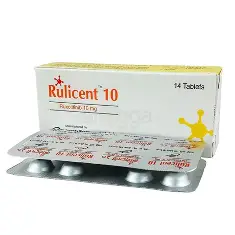
Rulicent 10-MG Tablet
Made in:
Brand:
Capacity:

Authentic Product

Easy Return

Secure payments and fast deliveries
Indications Myelofibrosis: Rulicent is indicated for treatment of intermediate or high-risk myelofibrosis (MF), including primary MF, post-polycythemia vera MF and post-essential thrombocythemia MF in adults. Polycythemia […]
Indications
Polycythemia Vera: Rulicent is indicated for treatment of polycythemia vera (PV) in adults who have had an inadequate response to or are intolerant of hydroxyurea.
Acute Graft-Versus-Host Disease: Rulicent is indicated for treatment of steroid-refractory acute graft-versus host disease (GVHD) in adult and pediatric patients 12 years and older.
Absorption: Ruxolitinib is rapidly absorbed after oral Ruxolitinib administration with maximal plasma concentration (Cmax) achieved within 1 to 2 hours post-dose. Oral absorption of ruxolitinib was estimated to be at least 95%. Distribution: The mean volume of distribution of ruxolitinib at steady-state is 72 L in patient with MF and PV in myelofibrosis patients.
Half-life: the mean half-life of ruxolitinib & metabolites is approximately 5.8 hours. Elimination half-life: The mean elimination half-life of ruxolitinib is approximately 3 hours AUC: Mean ruxolitinib Cmax and total exposure (AUC) increased proportionally over a single dose range of 5 to 200 mg.
The plasma protein binding: 97%, mostly to albumin. Metabolism: Ruxolitinib is metabolized by CYP3A4 and to a lesser extent by CYP2C9.
Excretion: Following a single oral dose of radio labeled ruxolitinib in healthy adult subjects, elimination was predominately through metabolism with 74% of radioactivity excreted in urine and 22% excretion via feces. Unchanged drug accounted for less than 1% of the excreted total radioactivity.
Dosage
- Platelet count greater than 200 X 10 9 /L: Starting dose 20 mg orally twice daily.
- Platelet count 100 X 10 9 /L to 200 X 10 9 /L: Starting dose 15 mg orally twice daily.
- Platelet count 50 X 10 9 /L to less than 100 X 10 9 /L: Starting dose 5 mg orally twice daily.
Polycythemia Vera: The recommended starting dose of Ruxolitinib is 10 mg twice daily. Doses may be titrated based on safety and efficacy. Consider decreasing the dose to 5 mg twice daily if the hemoglobin count 8 to less than 12g/dL and the platelet count 50 to less than 75 X 10 9 L.
Acute Graft-Versus-Host Disease: The recommended dose of Ruxolitinib is 5 mg twice daily. Consider increasing the dose to 10 mg twice daily after at least 3 days of treatment if the ANC and platelet counts are not decreased by 50% or more relative to the first day of dosing with ruxolitinib. Or as directed by the registered physician.
Administration
Interaction
Strong CYP3A4 Inhibitors: Concomitant administration of Rulicent with strong CYP3A4 inhibitors increases Rulicent exposure. Increased exposure may increase the risk of exposure-related adverse reactions. Consider dose reduction when administering Rulicent with strong CYP3A4 inhibitors. In patients with acute GVHD, reduce Rulicent dose as recommended only when coadministered with ketoconazole, and monitor blood counts more frequently for toxicity and adjust the dose if necessary when coadministered with itraconazole.
Strong CYP3A4 Inducers: Concomitant administration of Rulicent with strong CYP3A4 inducers may decrease Rulicent exposure. No dose adjustment is recommended; however, monitor patients frequently and adjust the Rulicent dose based on safety and efficacy.
Contraindications
Side Effects
- Thrombocytopenia, Anemia and Neutropenia
- Risk of Infection, bruising, dizziness, headache
- Symptom Exacerbation Following Interruption or Discontinuation of treatment with Rulicent
- Non-Melanoma Skin Cancer
Pregnancy & Lactation
Precautions & Warnings
Risk of Infection: Serious bacterial, mycobacterial, fungal and viral infections have occurred. Delay starting therapy with Rulicent until active serious infections have resolved. Observe patients receiving Rulicent for signs and symptoms of infection and manage promptly.
Tuberculosis: Tuberculosis infection has been reported in patients receiving Rulicent. Observe patients receiving Rulicent for signs and symptoms of active tuberculosis and manage promptly. Prior to initiating Rulicent, patients should be evaluated for tuberculosis risk factors, and those at higher risk should be tested for latent infection. Risk factors include, but are not limited to, prior residence in or travel to countries with a high prevalence of tuberculosis, close contact with a person with active tuberculosis, and a history of active or latent tuberculosis where an adequate course of treatment cannot be confirmed. For patients with evidence of active or latent tuberculosis, consult a physician with expertise in the treatment of tuberculosis before starting Rulicent. The decision to continue Rulicent during treatment of active tuberculosis should be based on the overall risk-benefit determination.
Progressive Multifocal Leukoencephalopathy: Progressive multifocal leukoencephalopathy (PML) has occurred with Rulicent treatment. If PML is suspected, stop Rulicent and evaluate.
Herpes Zoster: Advise patients about early signs and symptoms of herpes zoster and to seek treatment as early as possible if suspected.
Hepatitis B: Hepatitis B viral load (HBV-DNA titer) increases, with or without associated elevations in alanine aminotransferase and aspartate aminotransferase, have been reported in patients with chronic HBV infections taking Rulicent. The effect of Rulicent on viral replication in patients with chronic HBV infection is unknown. Patients with chronic HBV infection should be treated and monitored according to clinical guidelines.
Symptom Exacerbation Following Interruption or Discontinuation Of Treatment With Rulicent: Following discontinuation of Rulicent, symptoms from myeloproliferative neoplasms may return to pretreatment levels over a period of approximately one week. Some patients with MF have experienced one or more of the following adverse events after discontinuing Rulicent: fever, respiratory distress, hypotension, DIC, or multi organ failure. If one or more of these occur after discontinuation of, or while tapering the dose of Rulicent, evaluate for and treat any intercurrent illness and consider restarting or increasing the dose of Rulicent. Instruct patients not to interrupt or discontinue Rulicent therapy without consulting their physician. When discontinuing or interrupting therapy with Rulicent for reasons other than thrombocytopenia or neutropenia, consider tapering the dose of Rulicent gradually rather than discontinuing abruptly.
Non-Melanoma Skin Cancer: Non-melanoma skin cancers including basal cell, squamous cell, and Merkel cell carcinoma have occurred in patients treated with Rulicent. Perform periodic skin examinations.
Lipid Elevations: Treatment with Rulicent has been associated with increases in lipid parameters including total cholesterol, low-density lipoprotein (LDL) cholesterol, and triglycerides. The effect of these lipid parameter elevations on cardiovascular morbidity and mortality has not been determined in patients treated with Rulicent. Assess lipid parameters approximately 8-12 weeks following initiation of Rulicent therapy. Monitor and treat according to clinical guidelines for the management of hyperlipidemia.
Use in Special Populations
Overdose Effects
Therapeutic Class
Storage Conditions
| Capacity | 7 Tablets ( 1 Strips ) |
|---|
Related products
- Capacity: 10 Tablets (1 Strip)
৳ 500.00
- Capacity: 10 Tablets (1 Strip)
৳ 120.00
- Capacity: 10 tablet ( 1strip )
৳ 120.40
- Capacity: 10 Tablets (1 Strip)
৳ 30.10
- Capacity: 10 Tablets (1 Strip)
৳ 280.00



Reviews
There are no reviews yet.