


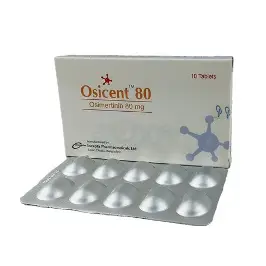
Osicent 80-MG Tablet
Made in:
Brand:
Capacity:

Authentic Product

Easy Return

Secure payments and fast deliveries
Indications Osicent is indicated for the first-line treatment of patients with metastatic non-small cell lung cancer (NSCLC) whose tumors have epidermal growth factor receptor (EGFR) exon […]
Indications
The area under the plasma concentration-time curve (AUC) and maximal plasma concentration (C max ) of Osimertinib increased dose proportionally over 20 to 240 mg dose range (i.e., 0.25 to 3 times the recommended dosage) after oral administration and exhibited linear pharmacokinetics (PK). Administration of Osimertinib orally once daily resulted in approximately 3-fold accumulation withsteady state exposures achieved after 15 days of dosing. At steady state, the C max to C min (minimal concentration) ratio was 1.6-fold.
Absorption: The median time to C max of Osimertinib was 6 hours (range 3-24 hours). Following administration of a 20 mg Osimertinib tablets with a high-fat, high-calorie meal (containing approximately 58 grams of fat and 1000 calories), the C max and AUC of Osimertinib were compared to that under fasting conditions.
Distribution: The mean volume of distribution at steady-state (Vss/F) of Osimertinib was 986 L. Plasma protein binding of Osimertinib was 95%.
Elimination: Osimertinib plasma concentrations decreased with time and a population estimated mean half-life of Osimertinib was 48 hours, and oral clearance (CL/F) was 14.2 (L/h).
Metabolism: The main metabolic pathways of Osimertinib were oxidation (predominantly CYP3A) and dealkylation in vitro. Two pharmacologically active metabolites (AZ7550 and AZ5104) have been identified in the plasma after Osimertinib oral administration. The geometric mean exposure (AUC) of each metabolite (AZ5104 and AZ7550) was approximately 10% of the exposure of Osimertinib at steady-state.
Excretion: Osimertinib is primarily eliminated in the feces (68%) and to a lesser extent in the urine (14%). Unchanged Osimertinib accounted for approximately 2% of the elimination.
Dosage & Administration
Interaction
Strong CYP3A Inducers: Avoid concomitant administration of Osicent with strong CYP3A inducers (e.g., Phenytoin, Rifampicin, Carbamazepine, St. John’s Wort) as strong CYP3A inducers may decrease Osicent plasma concentrations.
Effect on other drugs: Avoid concomitant administration of Osicent with drugs that are sensitive substrates of CYP3A, breast cancer resistance protein (BCRP), or CYP1A2 with narrow therapeutic indices, including but not limited to Fentanyl, Cyclosporine, Quinidine, Ergot Alkaloids, Phenytoin, Carbamazepine, as Osicent may increase or decrease plasma concentrations of these drugs.
Side Effects
Pregnancy & Lactation
Contraception: Females: Advise females of reproductive potential to use effective contraception during treatment with Osimertinib and for 6 weeks after the final dose. Males: Advise male patients with female partners of reproductive potential to use effective contraception during and for 4 months following the final dose of Osimertinib.
Infertility: Based on animal studies, Osimertinib may impair fertility in females and males of reproductive potential. The effects on female fertility showed a trend toward reversibility. It is not known whether the effects on male fertility are reversible.
Precautions & Warnings
QTc Interval Prolongation: Monitor electrocardiograms and electrolytes in patients who have a history or predisposition for QTc prolongation, or those who are taking medications that are known to prolong the QTc interval. Withhold then restart at a reduced dose or permanently discontinue Osicent.
Cardiomyopathy: Occurred in 1.4% of patients. Assess left ventricular ejection fraction (LVEF) before treatment and then every 3 months thereafter.
Embryo-Fetal Toxicity: Osicent can cause fetal harm. Advise females of potential risk to the fetus and to use effective contraception during treatment with Osicent and for 6 weeks after final dose. Advise males to use effective contraception for 4 months, after the last dose of Osicent.
Use in Special Populations
Pediatric Use: The safety and effectiveness of Osicent in pediatric patients have not been established.
Geriatric Use: No overall differences in effectiveness were observed based on age. Exploratory analysis suggest a higher incidence of Grade 3 and 4 adverse reactions (32% versus 25%) and more frequent dose modifications for adverse reactions (13.4% versus 9.3%) and more frequent dose modifications for adverse reactions (13.4% versus 7.6%) in patients 65 years or older as compared to those younger than 65 years.
Renal impairment: No dose adjustment is recommended in patients with mild, moderate or severe renal impairment. There is no recommended dose of Osicent for patients with end-stage renal disease.
Hepatic Impairment: There is no recommended dose for Osicent for patients with severe hepatic impairment.
Therapeutic Class
Storage Conditions
| Capacity | 10 Tablets ( 1Strips ) |
|---|
Related products
- Capacity: 10 Tablets (1 Strip)
৳ 80.00
- Capacity: 10 Tablets (1 Strip)
৳ 120.40
৳ 60.41
- Capacity: 10 Tablets (1 Strip)
৳ 60.20
- Capacity: 10 Tablets (1 Strip)
৳ 350.00


Reviews
There are no reviews yet.