


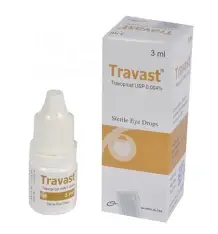
Travast Ophthalmic Solution 3-ML
Made in:
Brand:
Capacity:

Authentic Product

Easy Return

Secure payments and fast deliveries
Indications Travast, a prostaglandin analog is a selective FP prostanoid receptor agonist, which is believed to reduce IOP by increasing uveoscleral outflow. Travast, an isopropyl ester […]
Indications
Dosage & Administration
Pediatric Use: Use in pediatric patients below the age of 16 years is not recommended because of potential safety concerns related to increased pigmentation following long term chronic use.
Geriatric Use: No overall clinical differences in safety or effectiveness have been observed between elderly and other adult patients.
Interaction
Contraindications
Side Effects
Ocular adverse reactions, reported at an incidence of 1% to 4% in clinical trials with Travast ophthalmic solution 0.004%, included abnormal vision, blepharitis, blurred vision, cataract, conjunctivitis, corneal staining, dry eye, iris discoloration, keratitis, lid margin crusting, ocular inflammation, photophobia, subconjunctival hemorrhage, and tearing. Non ocular adverse reactions, reported at an incidence of 1% to 5% in these clinical studies, were allergy, angina pectoris, anxiety, arthritis, back pain, bradycardia, bronchitis, chest pain, cold/flu syndrome, depression, dyspepsia, gastrointestinal disorder, headache, hypercholesterolemia, hypertension, hypotension, infection, pain, prostate disorder, sinusitis, urinary incontinence, and urinary tract infections.
Pregnancy & Lactation
Precautions & Warnings
Eyelash Changes: Travast ophthalmic solution may gradually change eyelashes and vellus hair in the treated eye. These changes include increased length, thickness, and number of lashes.
Intraocular Inflammation: Travast ophthalmic solution should be used with caution in patients with active intraocular inflammation (e.g., uveitis) because the inflammation may be exacerbated.
Macular Edema: Macular edema, including cystoid macular edema, has been reported during treatment with Travast ophthalmic solution. Travast ophthalmic solution should be used with caution in aphakic patients, in pseudophakic patients with a torn posterior lens capsule, or in patients with known risk factors for macular edema.
Use with Contact Lenses: Contact lenses should be removed prior to instillation of Travast ophthalmic solution and may be reinserted 15 minutes following its administration.
Therapeutic Class
Storage Conditions
| Capacity | EYE Drop |
|---|
Related products
- Capacity: 10 Tablets (1 Strip)
৳ 220.00
- Capacity: 10 Tablets (1 Strip)
৳ 100.30
- Capacity: 10 Tablets (1 Strip)
৳ 60.20
- Capacity: 10 Tablets (1 Strip)
৳ 80.00
- Capacity: 10 Tablets (1 Strip)
৳ 80.00


Reviews
There are no reviews yet.