


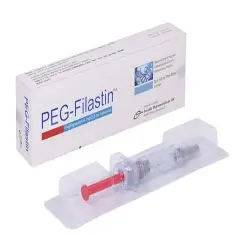
PEG-Filastin SC Injection
Made in:
Brand:
Capacity:

Authentic Product

Easy Return

Secure payments and fast deliveries
Indications PEG-Filastin is a leukocyte growth factor indicated to decrease the incidence of infection, as manifested by febrile neutropenia, in patients with non-myeloid malignancies receiving myelosuppressive […]
Indications
Dosage & Administration
NOTE: The needle cover on the single-use pre-filled syringe contains dry natural rubber (latex); persons with latex allergies should not administer this product.
Interaction
Contraindications
Side Effects
Acute Respiratory Distress Syndrome: Acute Respiratory Distress Syndrome (ARDS) can occur in patients receiving PEG-Filastin. Evaluate patients who develop fever and lung infiltrates or respiratory distress after receiving PEG-Filastin for ARDS. Discontinue PEG-Filastin in patients with ARDS.
Serious Allergic Reactions: Serious allergic reactions, including anaphylaxis can occur in patients receiving PEG-Filastin. The majority of reported events occurred upon initial exposure. Allergic reactions, including anaphylaxis can recur within days after the discontinuation of initial anti-allergic treatment. Permanently discontinue PEG-Filastin in patients: with serious allergic reactions. Do not administer PEG-Filastin to patients with a history of serious allergic reactions to PEG-Filastin or Filgrastim.
Patients with Sickle Cell Disorders: Severe sickle cell crises can occur in patients with sickle cell disorders receiving PEG-Filastin. Severe and sometimes fatal sickle cell crises can occur in patients with sickle cell disorders receiving Filgrastim, the parent compound of PEG-Filastin.
Pregnancy & Lactation
Nursing Mothers: It is not known whether Pegfilgrastim is secreted in human milk. Other recombinant G-CSF products are poorly secreted in breast milk and G-CSF is not orally absorbed by neonates. Caution should be exercised when administered to a nursing woman.
Precautions & Warnings
- Fatal splenic rupture can occur. Evaluate for splenomegaly or splenic rupture in patients with left upper abdominal or shoulder pain.
- Acute Respiratory Distress Syndrome (ARDS) can occur. Evaluate for ARDS in patients who develop fever, lung infiltrates, or respiratory distress. Discontinue PEG-Filastin in patients with ARDS.
- Serious allergic reactions, including anaphylaxis, can occur. Permanently discontinue PEG-Filastin in patients with serious allergic reactions.
Use in Special Populations
Geriatric Use: Of the 932 patients with cancer who received PEG-Filastin in clinical studies, 139 (15%) were age 65 and over, and 18 (2%) were age 75 and over. No overall differences in safety or effectiveness were observed between patients age 65 and older and younger patients.
Renal Impairment: In a study of 30 subjects with varying degrees of renal dysfunction, including end stage renal disease, renal dysfunction had no effect on the pharmacokinetics of PEG-Filastin. Therefore, PEG-Filastin dose adjustment in patients with renal dysfunction is not necessary.
Overdose Effects
Therapeutic Class
Storage Conditions
| Capacity | Injaction |
|---|
Related products
৳ 60.41
- Capacity: 10 Tablets (1 Strip)
৳ 40.10
- Capacity: 10 Tablets (1 Strip)
৳ 280.00
- Capacity: 10 Tablets (1 Strip)
৳ 100.30
- Capacity: 10 Tablets (1 Strip)
৳ 200.00


Reviews
There are no reviews yet.