


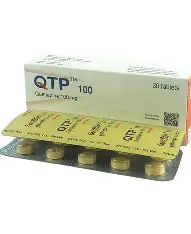
QTP 100MG Tablet
Made in:
Brand:
Capacity:

Authentic Product

Easy Return

Secure payments and fast deliveries
Indications QTP is indicated for the treatment of Acute and chronic psychoses, including schizophrenia, Bipolar Disorder including: treatment of manic episodes satisfying DSM-IV criteria for mania […]
Indications
Dosage & Administration
Manic episodes associated with bipolar disorder: Quetiapine should be administered twice daily, with or without food. The total daily dose for the first four days of therapy is 100 mg (Day 1), 200 mg (Day 2), 300 mg (Day 3) and 400 mg (Day 4). Further dosage adjustments up to 800mg/day by Day 6 should be in increments of no greater than 200 mg/day. The dose may be adjusted depending on clinical response & tolerability of the individual patient, within the range of 200 to 800 mg/day. The usual effective dose is in the range of 400 to 800mg/day.
Depressive episodes associated with bipolar disorder: Quetiapine should be administered once daily at bedtime, with or without food. The usual dose is 300 mg/day. The daily dose for the first four days of therapy is 50 mg (Day 1), 100 mg (Day 2), 200 mg (Day 3) and 300 mg (Day 4). Quetiapine can be titrated to 400 mg on Day 5 and up to 600mg by Day 8. Antidepressant efficacy was demonstrated with Quetiapine at 300mg and 600 mg, however no additional benefit was seen in the 600mg group during short term treatment.
Maintenance treatment of bipolar I disorder in combination with mood stabilizers: Patients who have responded to Quetiapine in combination therapy with a mood stabiliser for acute treatment of bipolar disorder should continue on Quetiapine therapy at the same dose. Quetiapine dose can be re-adjusted depending on clinical response and tolerability of the individual patient. Efficacy was demonstrated with Quetiapine (administered twice daily totalling 400mg to 800mg a day) as combination therapy with a mood stabilizer.
Interaction
Contraindications
Side Effects
Pregnancy & Lactation
Precautions & Warnings
- Suicide/suicidal thoughts or clinical worsening: Depression is associated with an increased risk of suicidal thoughts, self-harm and suicide (suicide-related events). This risk persists until significant remission occurs.
- Concomitant Illness: QTP should be used with caution in patients with known cardiovascular disease, cerebrovascular disease, or other conditions predisposing to hypotension. QTP may induce orthostatic hypotension especially during the initial dose-titration period.
- Seizures: As with other antipsychotics, caution is recommended when treating patients with a history of seizures.
- Tardive Dyskinesia and Extrapyramidal Symptoms (EPS): If signs and symptoms of tardive dyskinesia appear, dose reduction or discontinuation of QTP should be considered.
- Neuroleptic Malignant Syndrome: This syndrome has been associated with antipsychotic treatment. QTP should be discontinued and appropriate medical treatment given.
- QT Prolongation: As with other antipsychotics, caution should be exercised when QTP is prescribed in patients with cardiovascular disease or family history of QT prolongation.
- Neutropenia: Severe neutropenia (<0.5×10⁹/L) has been uncommonly reported in QTP clinical trials. Most cases of severe neutropenia have occurred within the first two months of starting therapy with QTP.
- Hyperglycemia & diabetes mellitus: Increases in blood glucose and hyperglycaemia, and occasional reports of diabetes, have been observed in clinical trials with QTP.
Use in Special Populations
Children and Adolescents: QTP is not indicated for use in children and adolescents below 18 years of age.
Overdose Effects
Therapeutic Class
Storage Conditions
| Capacity | 10 Tablets ( 1Strips ) |
|---|
Related products
- Capacity: 10 tablet ( 1strip )
৳ 120.40
- Capacity: 10 Tablets (1 Strip)
৳ 200.00
- Capacity: 10 Tablets (1 Strip)
৳ 80.00
- Capacity: 10 Tablets (1 Strip)
৳ 50.20
- Capacity: 10 Tablets (1 Strip)
৳ 120.00


Reviews
There are no reviews yet.