


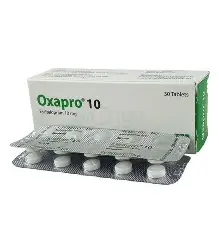
Oxapro 10MG Tablets
Made in:
Brand:
Capacity:

Authentic Product

Easy Return

Secure payments and fast deliveries
Indications Oxapro is indicated in the- Treatment of major depressive episodes. Treatment of panic disorder with or without agoraphobia. Treatment of social anxiety disorder (social phobia). […]
Indications
- Treatment of major depressive episodes.
- Treatment of panic disorder with or without agoraphobia.
- Treatment of social anxiety disorder (social phobia).
- Treatment of generalised anxiety disorder.
- Treatment of obsessive-compulsive disorder.
Dosage
Major depressive episodes: Usual dosage is 10 mg once daily. Depending on individual patient response, the dose may be increased to a maximum of 20 mg daily. Usually, 2-4 weeks are necessary to obtain an antidepressant response. After the symptoms resolve, treatment for at least 6 months is required for consolidation of the response.
Panic disorder with or without agoraphobia: An initial dose of 5 mg is recommended for the first week before increasing the dose to 10 mg daily. The dose may be further increased, up to a maximum of 20 mg daily, dependent on individual patient response. Maximum effectiveness is reached after about 3 months. The treatment lasts several months.
Social anxiety disorder: Usual dosage is 10 mg once daily. Usually, 2-4 weeks are necessary to obtain symptom relief. The dose may subsequently, depending on individual patient response, be decreased to 5 mg or increased to a maximum of 20 mg daily. Social anxiety disorder is a disease with a chronic course, and treatment for 12 weeks is recommended to consolidate response. Long-term treatment of responders has been studied for 6 months and can be considered on an individual basis to prevent relapse; treatment benefits should be re-evaluated at regular intervals. Social anxiety disorder is a well-defined diagnostic terminology of a specific disorder, which should not be confounded with excessive shyness. Pharmacotherapy is only indicated if the disorder interferes significantly with professional and social activities. The place of this treatment compared to cognitive behavioural therapy has not been assessed. Pharmacotherapy is part of an overall therapeutic strategy.
Generalised anxiety disorder: Initial dosage is 10 mg once daily. Depending on the individual patient response, the dose may be increased to a maximum of 20 mg daily. Long term treatment of responders has been studied for at least 6 months in patients receiving 20 mg/day. Treatment benefits and dose should be re-evaluated at regular intervals.
Obsessive-Compulsive Disorder: Initial dosage is 10 mg once daily. Depending on the individual patient response, the dose may be increased to a maximum of 20 mg daily. As OCD is a chronic disease, patients should be treated for a sufficient period to ensure that they are symptom-free. Treatment benefits and dose should be re-evaluated at regular intervals
Administration
Interaction
Contraindications
Side Effects
Pregnancy & Lactation
Precautions & Warnings
Use in Special Populations
Children and adolescents (<18 years): Oxapro should not be used in the treatment of children and adolescents under the age of 18 years.
Reduced renal function: Dosage adjustment is not necessary in patients with mild or moderate renal impairment. Caution is advised in patients with severely reduced renal function (CLCR less than 30 ml/min).
Reduced hepatic function: An initial dose of 5 mg daily for the first two weeks of treatment is recommended in patients with mild or moderate hepatic impairment. Depending on individual patient response, the dose may be increased to 10 mg daily. Caution and extra careful dose titration is advised in patients with severely reduced hepatic function.
Poor metabolizers of CYP2C19: For patients who are known to be poor metabolisers with respect to CYP2C19, an initial dose of 5 mg daily during the first two weeks of treatment is recommended. Depending on individual patient response, the dose may be increased to 10 mg daily. Discontinuation symptoms seen when stopping treatment. Abrupt discontinuation should be avoided.
When stopping treatment with escitalopram the dose should be gradually reduced over a period of at least one to two weeks in order to reduce the risk of discontinuation symptoms. If intolerable symptoms occur following a decrease in the dose or upon discontinuation of treatment, then resuming the previously prescribed dose may be considered. Subsequently, the physician may continue decreasing the dose, but at a more gradual rate.
Overdose Effects
Management: There is no specific antidote. Establish and maintain an airway, ensure adequate oxygenation and respiratory function. Gastric lavage and the use of activated charcoal should be considered. Gastric lavage should be carried out as soon as possible after oral ingestion. Cardiac and vital signs monitoring are recommended along with general symptomatic supportive measures. ECG monitoring is advised in case of overdose, in patients with congestive heart failure/bradyarrhythmias, in patients using concomitant medications that prolong the QT-interval, or in patients with altered metabolism, e.g. liver impairment.
Therapeutic Class
Storage Conditions
| Capacity | 10 Tablets ( 1Strips ) |
|---|
Related products
- Capacity: 10 Tablets (1 Strip)
৳ 80.00
- Capacity: 10 Tablets (1 Strip)
৳ 120.40
- Capacity: 10 Tablets (1 Strip)
৳ 350.00
- Capacity: 10 Tablets (1 Strip)
৳ 450.00
- Capacity: 10 Tablets (1 Strip)
৳ 250.00



Reviews
There are no reviews yet.