


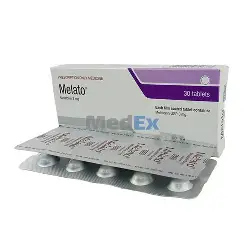
Melato 3MG Tablet
Made in:
Brand:
Capacity:

Authentic Product

Easy Return

Secure payments and fast deliveries
Indications Melato is used for numerous conditions but is showing the most promise in the short-term regulation of sleep patterns, including jet lag. Insomnia: Melato helps […]
Indications
Insomnia: Melato helps to induce sleep in people with-
- Disrupted circadian rhythms (such as those suffering from jet lag or poor vision or those who work the night shift)
- Low Melato levels (such as some elderly and individuals with schizophrenia)
- Children with learning disabilities who suffer from insomnia.
Osteoporosis: Melato stimulates cells called osteoblasts that promote bone growth.
In Menopause: Melato helps peri- or postmenopausal women to regulate sleep patterns.
Eating disorders: Melato levels may play a role in the symptoms of anorexia.
Attention Deficit Hyperactivity Disorder (ADHD): it may be effective in managing sleep disturbances in children with this condition. And
Sarcoidosis
Insomnia: 3-6 mg one hour before bedtime
Jet lag:
- 0.50 to 5 mg one hour prior to bedtime at final destination or, 1 to 5 mg 1 hour before bedtime for 2 days prior to departure and for 2 to 3 days upon arrival at final destination.
- Eastbound travel- Take a preflight early evening treatment followed by treatment at bedtime for 4 days after arrival.
- Westbound travel- Take for 4 days at bedtime when in the new time zone.
Sarcoidosis: 20 mg per day for 4 to 12 months.
Depression: 0.125 mg twice in the late afternoon, each dose 4 hours apart.
Difficulty falling asleep: 5 mg 3 to 4 hours before an imposed sleep period over a 4-weeks period.
Children (6 months to 14 years of age): For sleep disorders 0.30 mg/day
Antipsychotic Medications: People with schizophrenia and tardive dyskinesia taking antipsychotic medications with Melato has significantly reduced mouth movements compared to those who did not take the supplements.
Benzodiazepines: The combination of Melato and triazolam improves sleep quality. In addition, there have been a few reports suggesting that Melato supplements may help individuals stop using long-term benzodiazepine therapy.
Blood Pressure Medications: Melato may reduce the effectiveness of blood pressure medications like methoxamine and clonidine. In addition, calcium channel blockers (such as nifedipine, verapamil, diltiazem, amlodipine, nimodipine, felodipine, nisoldipine, and bepridil) may decrease Melato levels. The use of beta-blockers (propranolol, acebutolol, atenolol, labetalol, metoprolol, pindolol, nadolol, sotalol, and timolol) may reduce Melato production in the body.
Blood-Thinning Medications, Anticoagulants: Melato may increase the risk of bleeding from anticoagulant medications such as warfarin.
Interleukin-2: In one study of 80 cancer patients, the use of Melato in conjunction with interleukin-2 led to more tumor regression and better survival rates than treatment with interleukin-2 alone.
Nonsteroidal Anti-inflammatory Drugs (NSAIDs): NSAIDs such as ibuprofen may reduce the levels of Melato in the blood.
Steroids and Immunosuppressant Medications: People should not take Melato with corticosteroids or other medications used to suppress the immune system because the supplement may cause them to be ineffective.
Tamoxifen: Preliminary research suggests that the combination of tamoxifen (a chemotherapy drug) and Melato may benefit certain patients with breast and other cancers.
Other Substances: Caffeine, tobacco, and alcohol can all diminish levels of Melato in the body while cocaine and amphetamines may increase Melato production.
Pregnancy & Lactation
Precautions & Warnings
Overdose Effects
Therapeutic Class
Storage Conditions
| Capacity | 10 Tablets (1 Strip) |
|---|
Related products
- Capacity: 10 Tablets (1 Strip)
৳ 200.00
৳ 60.41
- Capacity: 10 Tablets (1 Strip)
৳ 120.40
- Capacity: 10 Tablets (1 Strip)
৳ 40.10
- Capacity: 10 Tablets (1 Strip)
৳ 280.00




Reviews
There are no reviews yet.