


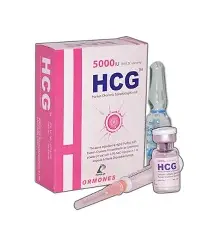
HCG IM/SC Injection 5000-IU
Made in:
Brand:
Capacity:

Authentic Product

Easy Return

Secure payments and fast deliveries
Indications In the female: Ovulation induction in infertility due to anovulation or impaired follicle-ripening. Preparation of follicles for puncture in controlled ovarian hyperstimulation programs (ART). Luteal […]
Indications
- Ovulation induction in infertility due to anovulation or impaired follicle-ripening.
- Preparation of follicles for puncture in controlled ovarian hyperstimulation programs (ART).
- Luteal phase support.
- Threatened and habitual abortion
In the male:
- Hypogonadotropic hypogonadism (also cases of idiopathic dysspermias have shown a positive response to gonadotropins).
- Delayed puberty associated with insufficient gonadotropic pituitary function.
- Cryptorchidism, (not due to anatomical obstruction)
- Used to treat oligospermia
- In the female: Human Chorionic Gonadotrophin is given as a substitute for the endogenous mid-cycle LH surge to induce the final phase of follicular maturation, leading to ovulation. Human Chorionic Gonadotrophin is also given as a substitute for endogenous LH during the luteal phase.
- In the male: Human Chorionic Gonadotrophin is given to stimulate Leydig cells to promote the production of testosterone.
Pharmacokinetic Properties: Maximal Human Chorionic Gonadotrophin plasma levels will be reached approximately six hours after a single injection of Human Chorionic Gonadotrophin . Human Chorionic Gonadotrophin is for approximately 80 percent metabolized, predominantly in the kidneys. Following intramuscular injection (IM) the apparent elimination half-life of Human Chorionic Gonadotrophin is about 2 days. On basis of the recommended dose regimens and elimination half-life, accumulation does not occur.
Dosage & Administration
In the female:
- Ovulation induction and preparation of follicles for puncture: Usually, one injection of 5000-10000 IU Human Menopausal Gonadotrophin to complete treatment with an FSH-containing preparation.
- Luteal phase support: Two repeat injections of 2500 to 5000 IU. Each may be given within nine days following ovulation or embryo transfer (for example on day 3, 6 and 9 after ovulation induction).
- Threatened & habitual abortion: 5000IU Human Menopausal Gonadotrophin will be given as deep intramuscular injection twice weekly from the time of diagnosis (all before the 7th week of gestation)
In the male:
- Hypogonadotropic hypogonadism: 2500 to 5000 IU Human Menopausal Gonadotrophin, two times per week. If the main complaint is sterility, additional doses of an FSH-containing (50IU FSH) are to be administered daily or two to three times a week. This treatment should be continued for at least three months before any improvement in spermatogenesis can be expected. During this treatment testosterone replacement therapy should be suspended. Once achieved, the improvement may in some cases be maintained by Human Menopausal Gonadotrophin alone.
Interaction
Contraindications
Side Effects
In the female: Unwanted ovarian hyperstimulation syndrome.
In the Male: Water and sodium retention is occasionally seen after administration of high dosages; this is regarded as a result of excessive androgen production. Treatment with HCG leads to increased androgen production.
Therefore: Patients with latent or overt cardiac failure, renal dysfunction, hypertension, epilepsy or migraine (or a history of these conditions) should be kept under close medical supervision, since aggravation or recurrence may occasionally be induced as a result of increased androgen production. HCG should be used cautiously in prepubertal boys to avoid premature epiphyseal closure or precocious sexual development. Skeletal maturation should be monitored regularly.
Pregnancy & Lactation
Use in lactation: It must not be used during lactation
Precautions & Warnings
Use in Special Populations
Geriatric Use: Clinical studies of Chorionic gonadotropin for injection did not include subjects aged 65 and over.
Overdose Effects
Therapeutic Class
Storage Conditions
| Capacity | Injaction |
|---|
Related products
৳ 60.41
- Capacity: 10 Tablets (1 Strip)
৳ 450.00
- Capacity: 10 Tablets (1 Strip)
৳ 150.00
- Capacity: 10 Tablets (1 Strip)
৳ 100.30
- Capacity: 10 Tablets (1 Strip)
৳ 60.20


Reviews
There are no reviews yet.